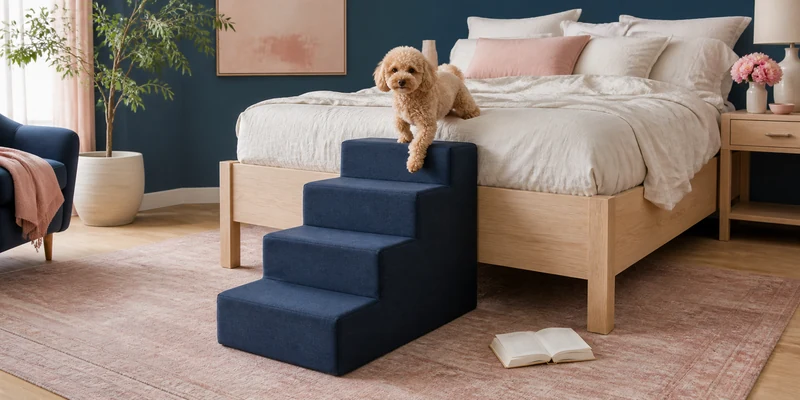
Last updated: August 10, 2026
Finding dog stairs for a high bed is a different search from finding pet steps in general. Modern mattresses on box springs, platform frames with thick hybrids, and adjustable bases routinely put the sleeping surface well above where standard three-step sets top out. The result is familiar to a lot of owners: a nice set of stairs that ends a full jump below the mattress, and a dog that either launches from the top step or refuses the whole arrangement.
This guide is about solving the height problem properly: how to measure, when to add steps instead of taller steps, and when a tall bed is really a ramp job in disguise. All of it applies to beds roughly two feet and up, which is where most standard pet steps stop being enough.
This article contains affiliate links. If you buy through them, we may earn a commission at no extra cost to you. Learn more.
Quick Answer
Which stairs work for a high bed?
- Count steps, not inches per step. A four-step or five-step set with shallow rises beats a three-step set with tall ones at the same total height.
- Measure floor to mattress top, then check the listed top-step height. The gap between top step and mattress should be one easy step, not a jump.
- Consider a ramp for seniors and long-backed breeds. Past couch height, many dogs find a gentle slope easier than a tall staircase; see our bed ramp guide.
Matching Stairs to Your Bed Height
Start with one number: the distance from the floor to the top of the mattress, measured with the bedding compressed the way it sits at night. Then use this overview to see what that number means.
| Bed height (floor to mattress top) | What usually works | Watch out for |
|---|---|---|
| Under about 20 inches | A standard 2-step or 3-step set from our dog stairs hub | Rise per step for small breeds |
| Around 20 to 25 inches | A tall 3-step or a 4-step set | Top step ending more than one easy step below the mattress |
| Around 25 to 30 inches | A 4-step or 5-step set, or a bedside ramp | Footprint: taller sets reach farther into the room |
| Above about 30 inches | A 5-step set for confident climbers, otherwise a ramp | Stability; at this height wobble is a dealbreaker |
These bands are practical guidance, not a standard: the deciding test is always whether your own dog walks up with all four paws in a relaxed rhythm. A dog that bunny-hops the steps is telling you the rises are too tall.
Why Tall Beds Break Standard Pet Steps
Manufacturers size mainstream pet steps around couches and average beds. When the mattress climbs higher, two things go wrong at once. First, the top-step gap: a set that reaches 19 inches next to a 28-inch mattress leaves a 9-inch ledge, and dogs treat that final hop, especially on the way down, as the same scary jump the stairs were meant to remove. Second, some makers close the gap by making each step taller instead of adding steps, which quietly turns walking into climbing.
The fix is almost always more steps rather than taller ones. More steps means a longer footprint beside the bed, which is the real trade-off of a tall bed: you are giving up floor space in exchange for a gentle climb. If the bedroom cannot spare that footprint, a ramp placed along the side of the bed instead of sticking out from it often fits better, which is one of the quiet advantages covered in our dog ramp for bed guide.
Our Top Picks for Tall Beds
How we chose: we compared tall pet step sets on top-step height, rise per step, stated weight capacity, and how often owners with high beds report the set actually reaching their mattress. Selections rest on manufacturer specifications and recurring review themes rather than our own testing.
Before the list, a note on nervous dogs: height amplifies hesitation. Whatever you buy, plan a short introduction with treats on the lower steps; the sequence in our training guide works for stairs as well as ramps.
🏆 Best Overall
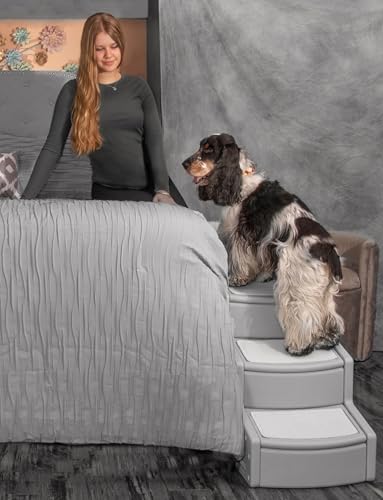
A four-step framed set with shallow rises, wide treads, and a removable washable tread cover, built specifically around tall bed heights. The default pick if your mattress sits in the mid-twenties of inches.
💛 Best Value
Tall foam steps with a high-density core and a machine-washable cover. A budget-friendly route to bed height for small and medium dogs, as long as the dog is light enough not to compress the foam.

🐕 Best for Hesitant and Long-Backed Dogs
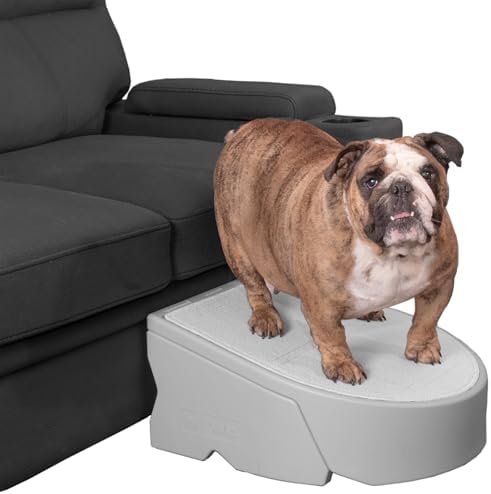
A stair and ramp hybrid that offers a continuous walking line with broad, shallow tiers. A strong middle path for dachshunds, corgis, and seniors who dislike conventional steps at height.
Small Dog, Big Dog: Height Changes the Math
Bed height interacts with dog size more than any other spec. A 26-inch mattress is roughly shoulder height for a Labrador and well over head height for a Maltese, so the same bed poses completely different problems.
- Small breeds need the most steps and the shallowest rises, and they benefit most from foam’s soft landings. Pair this guide with small dog stairs if your dog is under the fifteen-pound mark.
- Medium dogs handle four-step sets well; focus on tread depth so they are not placing paws in single file on the way down.
- Large and heavy dogs put real dynamic load on a tall unit. Framed or wood construction with a generous capacity margin matters more here than at couch height, because a wobble five steps up is a genuine fall risk.
- Seniors of any size often do better with a ramp once beds pass the mid-twenty-inch range; the full reasoning lives in stairs versus ramp, and the bigger home picture in senior dog mobility at home.
Two More Options Worth Considering
If the picks above do not quite fit your bedroom, these two round out the tall-bed field.
🛏️ Best for Very High Beds
A five-step foam tower for beds around thirty inches, sized for small and medium dogs. Its height demands a wall or bed frame alongside it for lateral stability, so place it snugly.
🐾 Also Great: Folding Space Saver
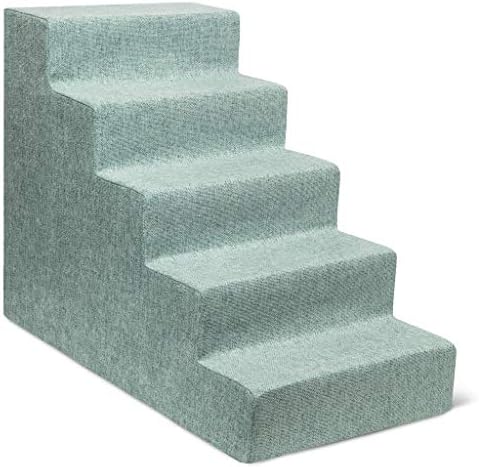
A folding step set that stows flat under the bed during the day. Useful in tight bedrooms where a permanent staircase footprint is the obstacle.

Setup: Placement, Gap, and Grip
Tall stairs are less forgiving of sloppy setup than short ones. Put the set where your dog actually enters and exits the bed, usually your side, and push the top step tight to the bed frame so there is no gap to slip a leg into. If the top step sits below the mattress, the transition should be a comfortable step down onto it, and the step surface there takes the most traffic, so check its grip first when things wear.
On hardwood or laminate, anchor the base: rubber feet plus a non-slip rug pad under the whole unit. Light foam towers also benefit from sitting against the nightstand or wall so they cannot tip sideways. Retighten framed sets after the first weeks of use, and wash covers before they polish smooth with fur and dust.
Common Mistakes with High-Bed Stairs
- Measuring the frame, not the mattress. The number that matters is floor to the top of the compressed mattress, which can sit several inches above the frame.
- Accepting a big top-step gap. If the last move is still a jump, the stairs have not solved the problem; they have moved it higher off the ground.
- Buying taller rises instead of more steps. Total height is only half the spec; rise per step is what your dog’s legs experience.
- Underestimating the footprint. A five-step set reaches well out from the bed. Check the depth measurement against your walkway before ordering.
- Putting a tall foam tower on a slick floor. Height multiplies the consequences of a slide. Base grip is non-negotiable past couch height.
- Forcing a nervous dog to the top. Height fears are learned in one bad moment and unlearned slowly. Start at the bottom steps with treats and let the dog set the pace.
Where to Go From Here
If your dog is light and the priority is soft footing, the density guidance in foam dog stairs will help you avoid the mushy sets. If the staircase footprint will not fit the bedroom, a slope along the bedside is the space-efficient answer in dog ramp for bed. And if the reason for the purchase is an older dog struggling with the height, it is worth pairing the access solution with the sleeping surface itself; our orthopedic dog bed guide covers the option of a supportive dog bed at floor level as an alternative to the climb entirely.
Frequently Asked Questions
How tall should dog stairs be for a high bed? Tall enough that the top step reaches the mattress or comes within one easy step of it. Measure floor to mattress top with the bedding compressed, then compare against the listed top-step height.
Are four-step or five-step dog stairs better? Whichever produces shallow rises at your bed’s height. For most beds in the mid-twenty-inch range a four-step set is right; around thirty inches, five steps or a ramp keeps the climb gentle.
Is a ramp better than stairs for a tall bed? Often, especially for seniors, small breeds, and long-backed dogs, because a slope removes the stepping motion entirely. The trade-off is length along the bedside; our comparison guide covers when each wins.
Can a small dog use stairs for a 30-inch bed? Yes, if the set has enough steps to keep each rise shallow and the unit is stable against the bed. Many owners of very small breeds find a ramp less intimidating at that height.
Why does my dog jump off the bed instead of using the stairs down? Descending is the scarier direction, and dogs default to the habit they know. Block the favorite launch spot for a while and reward calm walks down the steps; if the avoidance is new or paired with stiffness, check with your veterinarian.
The Bottom Line
For a high bed, buy stairs by two numbers: total height that actually reaches the mattress, and rise per step shallow enough that your dog walks rather than hops. More steps beats taller steps, stability becomes critical past couch height, and seniors or long-backed breeds often do better on a bedside ramp. Measure first, mind the footprint, and introduce the stairs gently.