Last updated: August 10, 2026
Nobody notices the day their dog becomes a senior. What you notice instead is a series of small edits the dog makes for himself: he waits at the bottom of the stairs a beat longer than he used to, takes the last step onto the couch as two moves instead of one, starts avoiding the hallway with the slick floor, or sleeps downstairs one night instead of following you up. Dogs are quiet about discomfort. By the time mobility changes are obvious, they have usually been underway for a while.
The encouraging part is how much of daily comfort lives in the home itself, and how much of it you can change this weekend: traction on the floors, the height of the things he climbs onto, where he sleeps, and how he gets in and out of the car. This guide walks through the whole house, in order of impact, and is honest about the boundary that matters most: the home setup supports a senior dog, and your veterinarian manages his health. Both jobs matter, and they are not interchangeable.
Quick Answer
How do you help a senior dog get around at home?
- Start with a veterinary visit: changed movement is a medical signal first, and much of what causes it can be managed once it is diagnosed.
- Then fix the house in impact order: traction on slick floors, a ramp or stairs for the furniture and car he uses daily, and a supportive bed with a low entry.
- Block the risky routes, like full staircases and slippery landings, with a gate rather than hoping he self-restricts.
The Senior Mobility Home Check
Walk your home with this table in hand and look at each area the way your dog experiences it. Most households find two or three rows that need attention immediately and a couple more worth watching.
| Area | What changes with age | What helps |
|---|---|---|
| Slick floors | Hardwood, tile, and laminate get harder to push off from; slips erode confidence fast | Rugs or runners along his actual routes, trimmed nails, tidy paw fur; traction aids if your veterinarian suggests them |
| Couch and bed | Jumping up and down becomes hesitant, then a hard landing risk | A ramp or pet stairs at the spot he already uses, taught patiently, plus a landing rug |
| Sleeping spot | Thin or saggy beds get harder to lie on and stand up from; more daytime sleep | A supportive foam bed with a low entry, away from drafts, on a non-slip base |
| Staircases | Full flights become the highest-risk feature in the house, especially going down | A gate at the top or bottom, carpet or treads on the steps, lights on at night |
| The car | The jump into a trunk or back seat is often the first thing a stiff dog refuses | A car ramp, the longest that fits, or a lift for small dogs |
| Food and water | Long walks to the bowl and slippery kitchen floors discourage drinking | Bowls on a mat, on his floor of the house, along a carpeted route |
| Routes and clutter | Tight squeezes and stepped thresholds start to trip a dog whose feet lift less | Clear wide paths to bed, door, and bowls; mark or ramp awkward thresholds |
Start With the Veterinarian, Not the Store
When an older dog moves differently, the first stop is a veterinary exam, and this is not a disclaimer, it is the correct order of operations. Stiffness, reluctance to jump, a changed gait, or new hesitation at stairs are symptoms, and the conditions behind them, from joint disease to pain that has other causes entirely, are things a veterinarian can diagnose and in many cases manage. A dog whose discomfort is being treated gets far more benefit from every change in this guide, and some changes, like exercise adjustments or traction aids, are best chosen with veterinary input for your specific dog.
Bring observations to the appointment, because you see what the exam room cannot: which step he hesitates at, whether mornings are worse than evenings, what he has quietly stopped doing. Video on your phone of the walk and the stairs is genuinely useful. And keep the veterinarian in the loop as things evolve, since senior mobility is a moving target and a plan from two years ago may not fit the dog in front of you.
What the rest of this guide covers is the part that is squarely yours: an environment that asks less of an aging body, whatever the diagnosis turns out to be.
Floors and Traction: The Cheapest Big Win
If you change one thing, change this. Older dogs lose strength and precision in their hindquarters, and a slick floor punishes both at once: they splay on push-off, scramble on turns, and after a few slips many seniors start refusing rooms and corridors entirely. Owners often read that refusal as stubbornness. It is usually a rational risk assessment.
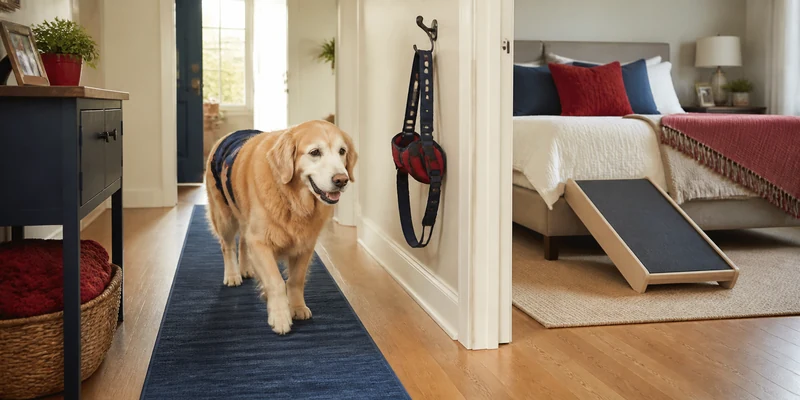
The fix is unglamorous and effective: put traction where the dog actually walks, not where a rug looks best. Follow him for a day and note his real routes, bed to door, door to bowls, couch to your chair, then lay runners and non-slip rugs along those lines, with rug pads or grippy backing so the rug itself is not the hazard. Pay special attention to launch and landing zones: in front of the couch, at the foot of the bed, at the bottom of any steps, and the kitchen floor around the bowls.
Then look at the feet. Long nails change how a paw meets the floor and make slipping worse, and fur growing between the paw pads turns even a modest floor into a skating rink for some breeds. Regular nail trims and keeping paw fur tidy are traction work as much as grooming. Beyond that, various traction aids exist, from grippy socks to nail grips, with mixed tolerance from dog to dog; if slipping persists on good flooring, that is worth raising with your veterinarian rather than solving by trial and error alone.
Getting On and Off Furniture: Ramps and Stairs
The couch and your bed are usually where mobility changes show up first, because jumping is the movement that goes early. The goal is simple: replace the jump with a walk. Two tools do it, and they suit different dogs.
Pet stairs take up little floor space and suit dogs who still climb comfortably but should not be jumping. Ramps remove steps entirely and suit dogs who have begun hesitating at stairs too; the rule that matters is that longer is gentler, so buy the longest ramp the room allows rather than the most compact one. Whichever you choose, it needs a non-slip walking surface, a stable base that does not shift when the dog commits his weight, and placement at the exact spot the dog already uses to get up. The full decision, with the cases where each wins, is in dog stairs or ramp, and the buying guides are dog stairs and dog ramps, with tall beds getting their own treatment in dog ramps for beds.
Two practical notes from a thousand owner experiences. First, dogs do not automatically understand ramps, and a senior who is rushed onto one will avoid it afterward; a few short, treat-paid sessions make the difference, and teaching your dog to use a ramp walks through it step by step. Second, decide what the dog is allowed to do and make it consistent. A dog who is lifted onto the bed some nights and expected to use the ramp on others never learns the new route.
The car deserves the same thinking, because the leap into a trunk is one of the biggest asks in a dog’s week and often the first thing a stiff dog refuses. A folding car ramp turns loading into a walk, and teaching it on a shallow angle first makes the real thing uneventful.
Sleeping: Support and a Low Entry
Senior dogs sleep more hours and get up more times, so the bed does more work than any other object they own. Two properties matter most, and they pull in the same direction. Support: a dense foam surface that holds the dog’s weight evenly instead of letting him sink to the floor through flattened fill, which also makes standing up an easier push. And entry: a low step-in height with no tall bolster wall on the approach side, so getting in at night and out at dawn asks nothing of stiff joints. Softness is the property owners overpay for; deep plush is genuinely harder for a stiff dog to rise from.
Position the bed on his terms: on the floor of the house where the family spends evenings, out of drafts, on a rug or grippy base so the bed does not skate on push-off, and with a clear route to the door for the nighttime trip outside. If he sleeps upstairs with you, consider a second bed downstairs for daytime, which quietly removes dozens of stair trips a week. The buying side of this, foam density, entry height, washable and waterproof covers for the accident risk that rises with age, is covered in orthopedic dog beds and specifically in orthopedic beds for senior dogs.
Stairs, Barriers, and the Routes You Close
Part of a senior setup is deciding which routes are no longer his, and enforcing that kindly with hardware instead of hope. Full staircases are the biggest risk in most homes, especially going down, where a misstep becomes a fall. If the dog no longer needs to be upstairs, a dog gate at the bottom, or the top, turns a daily hazard into a non-event. If he does still use the stairs, treads or a carpet runner on bare wood steps, good lighting at night, and an escort on the trip down are the practical middle ground.
Think the same way about other risky features: the slippery landing he crosses to reach the yard, the three brick steps at the back door that could carry a small ramp, the pile of shoes narrowing the hallway he now navigates less precisely. None of these require products so much as attention. A senior dog’s world can shrink a little without shrinking his life, as long as the spaces he keeps are the ones with his people in them.
Common Mistakes With Senior Dogs at Home
- Skipping the veterinary visit. Slowing down is not a diagnosis. Treatable conditions hide behind it, and every home change works better on a dog whose discomfort is managed.
- Reading avoidance as stubbornness. A dog who refuses a floor, a staircase, or the car is reporting something. Believe him first, investigate second.
- Buying a plusher bed instead of a supportive one. Deep soft beds are harder to stand up from. Seniors need dense support and a low entry.
- Installing a ramp and never teaching it. An untrained ramp is furniture in the way. Short, rewarded sessions make it the obvious route.
- Being inconsistent. Lifted up some days, expected to use the stairs other days: the dog never learns the system. Pick the rule and keep it.
- Changing everything at once. Older dogs lean on routine. Introduce one change at a time and let each become normal.
Where to Go From Here
Most households start with the furniture question, and dog stairs or ramp settles it for your specific dog and space. The sleeping upgrade is next, via orthopedic beds for senior dogs. And if you are reworking rooms anyway, sizing everything to the actual dog, entry heights, bed dimensions, gate widths, is covered in how to measure your dog for furniture.
Frequently Asked Questions
What are the first signs of mobility change in an older dog? Hesitating at stairs or before jumping, taking jumps in stages, slipping on smooth floors, slower rising after sleep, and quietly avoiding places he used to go. Any of these is worth a veterinary visit, since they are symptoms rather than plain aging.
Should an older dog use stairs or a ramp? Stairs suit dogs who still climb well but should not jump; ramps suit dogs hesitant at steps, and longer ramps mean gentler slopes. The full comparison is in dog stairs or ramp.
How do I stop my senior dog slipping on hard floors? Runners and non-slip rugs along his actual routes, regular nail trims, and tidy paw-pad fur solve most of it. Persistent slipping despite good traction is worth discussing with your veterinarian.
What kind of bed is best for a senior dog? Dense supportive foam with a low entry, a non-slip base, and a washable cover. Support beats softness, because very plush beds are harder for stiff dogs to stand up from. See orthopedic beds for senior dogs.
Should I block the stairs for my older dog? If he no longer needs to be up there, yes: a gate removes the riskiest feature in the house. If he still uses stairs, add traction to the steps, light them at night, and supervise the trip down.
Can home changes replace veterinary care for an arthritic dog? No. Home changes reduce what the day demands of his body; diagnosis and management of the condition itself is your veterinarian’s work. The two together are what a comfortable senior looks like.
The Bottom Line
Helping a senior dog at home starts at the veterinary clinic and continues in impact order: traction along his real routes, a ramp or stairs where he climbs daily, a supportive low-entry bed, and a gate across the routes that are no longer safe. Teach each change patiently, keep the rules consistent, and let his world stay rich while asking less of his body. The house cannot make a dog younger, but it can make every one of his days easier.