Last updated: August 10, 2026
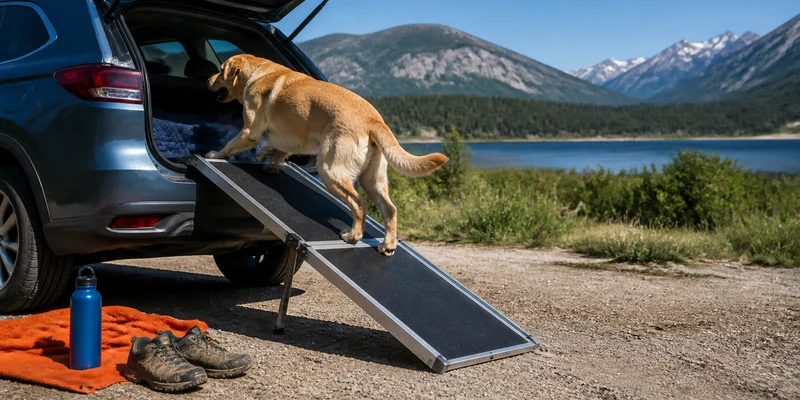
A dog ramp for the car earns its keep twice on every trip: once for the dog that no longer has to leap into a cargo area at chest height, and once for the owner who no longer has to lift a sixty-pound animal over a bumper. SUVs and trucks have grown tall enough that even healthy adult dogs land hard jumping out, and for seniors, big breeds, and anything recovering from a procedure, the tailgate becomes a genuine barrier.
Car ramps are also the most demanding ramp category: they must be light enough to deploy one-handed in a parking lot, rigid enough not to bounce mid-span, gripped enough to work in the rain, and compact enough to live in the trunk. This guide covers what separates the good ones, how to match length to your vehicle, and the models owners of SUVs and trucks consistently land on.
This article contains affiliate links. If you buy through them, we may earn a commission at no extra cost to you. Learn more.
Quick Answer
What should a car dog ramp have?
- Length matched to your vehicle: the taller the cargo floor, the longer the ramp needs to be to keep the slope walkable. Telescoping designs give the most flexibility.
- Wet-weather grip and side rails, because tailgates meet rain, mud, and wet paws as a matter of course.
- A rigid deck with secure ends: no bounce in the middle, rubber feet on the ground, and a lip seated firmly on the tailgate every single time.
Car Ramp Checklist: Match the Ramp to the Vehicle
Start by measuring from the ground to your cargo floor or seat entry, then use this table to translate that number and your dog into specs.
| What to check | Why it matters in a vehicle | What to look for |
|---|---|---|
| Extended length | Length sets the slope at your tailgate height; short ramps get steep | The longest ramp your trunk can store; telescoping models adjust per situation |
| Folded or collapsed size | The ramp rides along on every trip | A folded footprint that fits your cargo area with the dog also aboard |
| Deck stiffness | A flexing span bounces underfoot exactly when the dog commits | Stated capacity well above your dog’s weight and no sag complaints in reviews |
| Surface traction | Rain, mud, and pond water are part of the job | Grit-style coating or textured rubber that owners confirm grips when wet |
| End security | Most car-ramp accidents are the ramp sliding off the tailgate | A rubberized lip or hooks at the top, rubber feet at the bottom |
| Carry weight and handle | You deploy it in parking lots, one hand on the dog | Light enough to lift comfortably, with a handle or strap for carrying |
| Width and side rails | Dogs drift on narrow decks, especially descending | A deck wide enough for your dog’s gait, with raised edges as a visual guide |
Heavier and less confident dogs push every one of these specs upward: wider, stiffer, grippier, longer. A ramp with no margin is a ramp that gets refused.
Why Length Beats Everything Else
The steepness your dog walks is simple geometry: cargo-floor height divided by ramp length. A typical SUV cargo floor sits somewhere around knee to hip height on an adult; reach that with a short ramp and you have built a slide, reach it with a long or fully extended telescoping ramp and you have built a walkway. No coating or rail can compensate for a slope the dog reads as a cliff, and descending, always the harder direction, is where a too-steep ramp fails first.
There is no official maximum angle for pet ramps, so use the walking test: a relaxed, normal-paced walk both directions, no crouching, no rushing the last few feet. You can also cheat the geometry in your favor at the curb: park where the ground is flat, angle the ramp toward the lowest entry point, or use the side door sill instead of the rear hatch when the vehicle offers a lower entry there. For dogs that need convincing, the flat-ground introduction in teaching your dog to use a ramp is worth doing before the first road trip, not during it.
Our Top Picks for Cars, SUVs, and Trucks
How we chose: we compared vehicle ramps on extended length, deck stiffness, wet-surface traction, folded size, and how consistently owners of SUVs and trucks report reliable daily use. Selections rest on manufacturer specifications and recurring review themes rather than any hands-on trial of our own.
One reassurance up front: a dog that balks at the tailgate ramp on day one is the norm, not a verdict. Nearly all of them walk it happily within a week of short, rewarded practice runs.
🏆 Best Overall
A telescoping ramp with a wide deck and a high-traction walking surface that extends long for a gentle slope, then slides compact for the trunk. The most adaptable answer across SUVs, crossovers, and wagons.
💛 Best Value
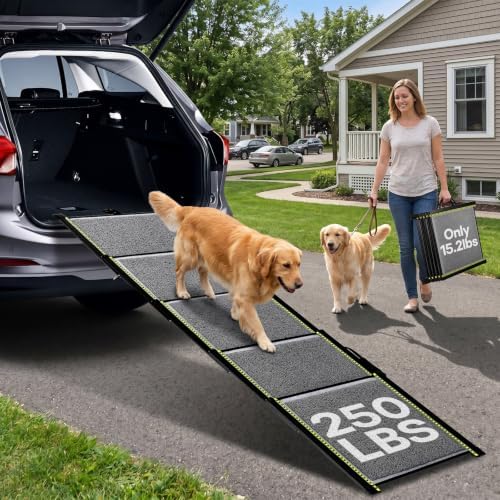
A lightweight tri-fold ramp with a gripping tread surface, easy to lift one-handed and quick to stow. A strong first ramp for sedans, crossovers, and moderate cargo heights.

🐕 Best Heavy-Duty
A modular platform loader that assembles into wide, rigid tiers for tall truck beds and large SUVs. Bulkier than a folding ramp, but the stable choice for big dogs at serious heights.

Trucks, Sedans, and Everything Between
Vehicle type changes the problem more than dog type does, so it is worth matching by what you drive.
- Sedans and hatchbacks have low entries, so a shorter folding ramp is usually enough, and folded size matters more than maximum length. Some small-dog owners skip the ramp and use portable steps at the door sill instead; both routes are covered in our dog ramp hub.
- SUVs and crossovers are the classic telescoping-ramp customer: cargo floors high enough to need real length, trunks big enough to store it.
- Pickup trucks are the extreme case. Tailgate heights push conventional ramps toward their steep limit, which is where platform-style loaders and the longest telescoping models earn their bulk. Bed-side rails and a helper on the first climbs are sensible at this height.
- Vans with low floors sometimes need no ramp at all for a healthy dog, but seniors still appreciate one; a stiff dog is stiff at every height, as our overview of senior dog mobility at home lays out for the house side of the same problem.
If your dog has recently stopped jumping into a familiar car, treat that as information: reluctance that appears out of nowhere is worth a veterinarian visit before, or alongside, the ramp purchase.
If the Trunk Is Tight: Compact Options
Storage kills more car-ramp habits than anything else; a ramp that fights for space with groceries and the dog eventually stays in the garage. Two designs specifically solve the packing problem.
🚗 Best for Small Trunks
A compact folding ramp that collapses into a slim, flat package with a carry handle, sized for crossovers and sedans where every inch of cargo space counts.

🐾 Also Great: Ultra-Light Carry
A featherweight folding ramp built around easy handling, for owners who deploy and stow the ramp many times a day or have limited lifting strength themselves.
Loading Routine: The Two-Minute Habit That Prevents Accidents
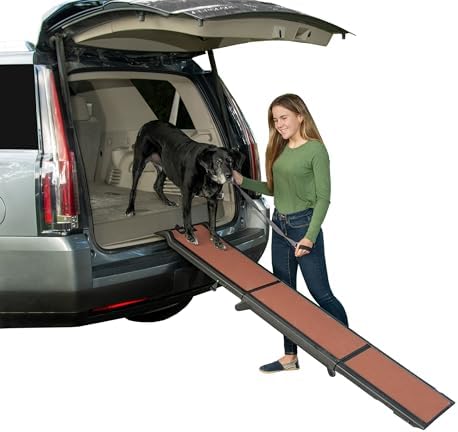
A car ramp is a system with two failure points, and both are checked in seconds. At the top, seat the lip fully on the tailgate or bumper and give the ramp a firm push sideways before the dog touches it; if it walks, reposition it. At the bottom, plant the feet on the flattest ground available, avoiding gravel slicks and painted lot markings, which are slippery when wet. Guide the dog from the side rather than pulling from the front, and keep the first and last steps slow, since dogs love to leap the final foot.
Afterward, the maintenance is minimal but real: rinse off mud and road grit, let the deck dry before folding it away, and check the rubber feet and hinges every season. Grit ground into a traction coating polishes it smooth over time, which is how a ramp that gripped last summer quietly stops gripping.
Common Mistakes with Car Ramps
- Buying for the trunk instead of the tailgate. Compactness is worthless if the extended length makes the slope a slide. Solve slope first, storage second.
- First use at the vehicle. A parking lot with a waiting car is the worst classroom. Introduce the ramp flat at home first, per the training guide.
- Skipping the sideways push test. The five-second check of the tailgate connection is the cheapest accident prevention in this category.
- Ignoring wet grip reviews. Every surface grips dry. The reviews that mention rain are the ones that matter.
- Letting the dog exit by jumping anyway. Downhill is where the joint load lives. Leash-guide the exits until walking down is the habit.
- Under-buying for a truck. Tailgate height is not SUV height. At truck elevation, go long, go rigid, or go platform-style.
Where to Go From Here
If storage constraints are driving the decision, the fold-size deep dive in folding dog ramp compares collapsed footprints and carry weights. If your dog also struggles onto the bed or couch, one purchase rarely covers both jobs; the indoor side lives in dog ramp for bed. And for the full category picture, from slope math to indoor freestanding models, start at the hub: best dog ramp.
Frequently Asked Questions
How long should a dog ramp be for an SUV? Long enough that the slope from the ground to your cargo floor is a walk, not a climb, which for typical SUV heights means the longer end of the market. Measure ground to cargo floor, then buy the longest ramp your trunk can store; telescoping models let you fine-tune per parking spot.
Are dog ramps safe for trucks? Yes, with the right equipment: maximum length or a platform-style loader, a rigid deck, and a firmly seated tailgate connection. Truck heights are the hardest case, so margin matters more here than anywhere.
Ramp or steps for getting a dog into a car? Ramps suit most vehicles and most dogs, especially seniors and large breeds; platform steps shine at truck height for dogs that prefer stepping. The general decision framework is in dog stairs or ramp.
My dog refuses the car ramp. What now? Go back a step: practice on the ramp lying flat at home, reward every crossing, then raise it gradually. Refusals almost always mean too steep, too slippery, or a scare, not a stubborn dog.
How much weight can a car dog ramp hold? Models vary, and the stated capacity should sit comfortably above your dog’s weight, since a walking dog loads the deck dynamically. If the deck visibly flexes under your dog, size up regardless of the rating.
Do I need a ramp if my dog can still jump in? Jumping in is rarely the issue; jumping out is, because the landing loads the front legs. Many owners start the ramp habit before it is strictly needed, particularly with large breeds that are hard to lift later. If in doubt about your dog’s joints, ask your veterinarian.
The Bottom Line
A car dog ramp is bought on length for a walkable slope, a deck that stays rigid and grips when wet, and end connections you check every load. Match the ramp to the vehicle: folding for low entries, telescoping for SUVs, maximum length or a platform loader for trucks. Train on flat ground first, guide the exits, and the tailgate stops being a barrier for good.