Last updated: August 10, 2026
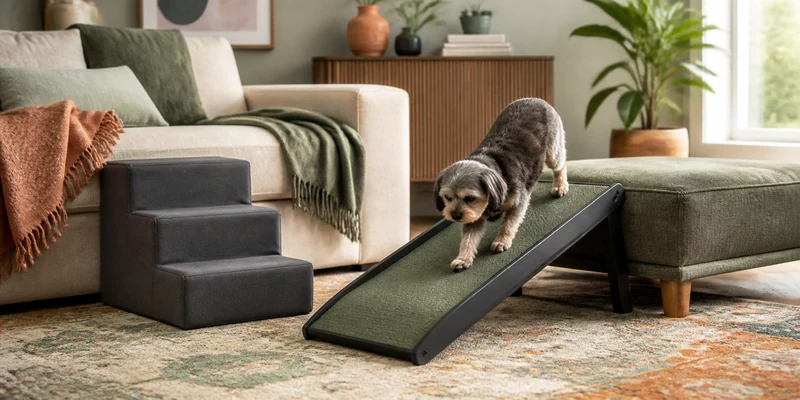
Dog stairs or ramp: it sounds like a coin flip, and owners often buy whichever one appears first in the search results, then discover their dog has a strong opinion. The two solve the same problem, getting a dog on and off furniture or into a car without jumping, but they solve it with different movements. Stairs still ask your dog to climb; a ramp asks your dog to walk. Which motion suits your dog depends on age, body shape, confidence, and the height involved.
This comparison lays out where each option genuinely wins, which dogs belong firmly in one camp, and how to decide for the gray-zone cases. By the end you should know which category to shop, and just as importantly, which one to skip.
Quick Answer
Should you get dog stairs or a ramp?
- Choose a ramp for senior dogs, long-backed breeds like dachshunds, post-surgery recovery, and anything car-related. A slope removes the stepping motion entirely.
- Choose stairs for healthy, confident climbers in rooms where floor space is tight, since steps reach the same height in a fraction of the footprint.
- When in doubt, the ramp is the safer default: almost every dog can walk a gentle slope, but not every dog can step a staircase comfortably.
Stairs vs. Ramp: The Differences at a Glance
Here is the whole decision in one table. The rows where your situation lands hardest should decide your category.
| Factor | Dog stairs | Dog ramp |
|---|---|---|
| Movement asked of the dog | A climbing motion: lifting legs over each rise | A continuous walk up a slope, no stepping |
| Floor space | Compact; reaches height in a short footprint | Long; a gentle slope needs real length |
| Senior and stiff dogs | Workable if rises are shallow; steps can stay hard | Usually the easier and preferred option |
| Long-backed breeds | Awkward; short legs and long spines dislike rises | The standard recommendation |
| Small dogs | Good with low rises and enough steps | Good; often less intimidating at tall heights |
| Large, healthy dogs | Fine for furniture heights | Fine; wins for vehicles |
| Cars and trucks | Rarely practical except platform-style loaders | The default solution |
| Learning curve | Familiar motion; most dogs adopt fast | Slopes are novel; usually needs a short introduction |
| Always-deployed use (bedside) | Easy; small footprint stays out of the way | Needs a wall or bedside line to live along |
Read the table by your dog first and your room second: the dog decides the motion, the room decides the format.
What You Are Really Comparing: Two Different Movements
The physical difference is easy to underestimate. Stairs break a jump into smaller vertical efforts, but each step still requires the dog to flex and extend joints through a climbing motion, and to place paws precisely, which is exactly what gets harder with age, arthritis-related stiffness, or a long, low build. A ramp converts all of that into plain walking, the one gait almost every dog keeps until the very end.
The cost of the ramp’s gentleness is geometry. To stay gentle, a slope needs length: reaching bed height in a walkable grade takes several feet of run, where a staircase does it in a couple of square feet of bedroom. There is no official standard for pet-ramp steepness, so the practical test is watching your dog: a relaxed walk both directions means the slope is right, while crouching, rushing, or scrambling means it is too steep, and a too-steep ramp loses to a good staircase every time.
Which Dog Do You Have?
Most dogs fall clearly into one column once you look at body, age, and destination.
- The senior. Ramp, almost always. Stiff joints keep walking long after they stop climbing comfortably, and unsupervised nighttime bed access favors the motion that cannot be misjudged. Pair the choice with the wider adjustments in senior dog mobility at home, and let your veterinarian weigh in if the slowdown is recent.
- The dachshund, corgi, or basset. Ramp. Long spines and short legs make rises awkward and landings risky, which is why breed communities talk about ramps constantly.
- The healthy small dog. Either works; the deciding factor is usually space. Tight bedroom, go stairs with shallow rises; room to run a slope along the bed, the ramp is a touch kinder over a lifetime.
- The big, athletic dog. Stairs are fine indoors and barely needed at couch height; the ramp question really arrives at the tailgate, where a slope protects joints and your back at once.
- The recovering patient. Whatever your veterinary team specifies, which is usually a ramp and often supervised use only. Recovery is the one case where you follow instructions rather than preferences.
- The nervous first-timer. Slight edge to stairs at first, since stepping is familiar, but a properly introduced ramp wins most converts within a week; the method is in teaching your dog to use a ramp.
Decide by Destination, Too
The place your dog is trying to reach often settles the question on its own. For the couch, either option works and stairs’ small footprint usually wins the living room. For the bed, height starts to favor the ramp, especially for the senior and long-backed dogs who need bed access most; a slope along the bedside costs little walking space. For vehicles, the comparison collapses: conventional stairs do not work at a tailgate, so it is a ramp or a platform-style loader, full stop.
There is also a hybrid worth knowing: stair-ramp combination units with broad, shallow tiers that give a continuous walking line in a stair-sized footprint. They suit dogs that distrust slopes but struggle with standard rises, and they show up in both of our buying guides.
Common Mistakes in This Decision
- Choosing by your convenience alone. Stairs store prettier; that does not help a dog that bunny-hops them. The dog’s movement quality is the test.
- Buying a short ramp to save space. A ramp only beats stairs when the slope stays gentle. If the space forces a steep ramp, well-sized stairs are the better tool.
- Assuming the dog will figure it out. Stairs usually yes, ramps usually not without a short introduction. Budget a week of treats either way.
- Ignoring what refusal is telling you. A dog that suddenly avoids familiar stairs may find climbing painful, and that is a veterinarian conversation before it is a shopping decision.
- Solving only half the day. The dog that needs help onto the bed also needs help off the couch and into the car. Audit all the daily heights once, then buy deliberately.
- Waiting for a crisis. Dogs learn ramps and stairs fastest while still fit. Owners of large and long-backed breeds in particular do well starting the habit years early.
Ready to Choose?
If this comparison pointed you at steps, the construction types, sizing rules, and picks are in our guide to the best dog stairs. If the slope column won, start with the best dog ramps, which splits the category into indoor and vehicle models. And if an aging dog prompted the question, the sleeping surface is the other half of the comfort equation; see what genuinely supportive means in a orthopedic dog bed.
Frequently Asked Questions
Are ramps or stairs better for older dogs? Ramps, in most cases. A slope replaces the climbing motion that stiff joints handle worst, and it stays manageable as mobility declines further. Shallow-rise stairs are a workable second where space is tight.
Are stairs or a ramp better for a dachshund? A ramp. Long-backed, short-legged breeds handle rises awkwardly and benefit most from removing jumps and steps entirely; a gentle, grippy slope is the breed-standard advice.
Do dogs prefer stairs or ramps? Untrained dogs often try stairs first because stepping is familiar, but preference follows experience: after a proper introduction, most dogs use whichever is present. Comfort with the motion, not novelty, decides long-term use.
Is a ramp or stairs better for a high bed? The higher the bed, the more the ramp wins, because staircases at that height get tall, deep, and harder to place. If space rules out a gentle slope, a shallow-rise tall step set is the fallback; see dog stairs for high beds.
What about getting into the car? That one is not a real contest: conventional pet stairs are not built for tailgates, so vehicles mean a ramp or a platform-style loader. The vehicle specifics live in dog ramp for car.
Can I use both? Many households do: stairs at the couch where space is tight, a ramp at the bed and the car. The combination covers every height with the motion that suits it best.
The Bottom Line
Choose a ramp for seniors, long-backed breeds, recovery periods, and anything involving a vehicle; choose stairs for healthy climbers in tight spaces. A gentle slope is the more universally usable motion, but only if you can give it the length it needs, and a too-steep ramp loses to good stairs every time. Decide by your dog’s movement first, your floor plan second, and buy before the crisis rather than after.