Last updated: August 10, 2026
Almost every disappointing dog furniture purchase traces back to the same mistake: buying by breed name or by the size label instead of by the dog. Labels are not standardized, one brand’s Large is another brand’s Medium, and dogs vary so much within a breed that “fits Labs” tells you almost nothing about your Lab. Meanwhile the fix costs nothing and takes ten minutes: a tape measure, a treat, and five numbers written somewhere you can find them again.
This guide shows you exactly how to measure your dog for furniture, then translates those numbers into the sizes that matter for crates, beds, gates, ramps, and stairs, so every future purchase starts from the same short list instead of a guess.
Quick Answer
How do you measure a dog for furniture?
- Take five numbers: standing length (nose to tail base), standing height at the head, shoulder height, sleeping length or curl width, and weight.
- Always compare your numbers against the product’s interior or usable dimensions, never the outer frame size.
- When you land between two sizes, go up, for every furniture type except gates, where fit beats generosity.
The Five Measurements, Step by Step
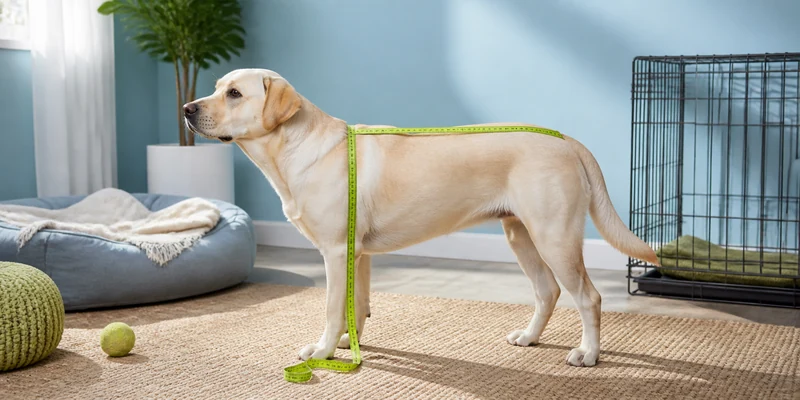
Grab a soft tape measure, or a piece of string and a ruler, and a helper with treats if your dog is wiggly. Measure on a standing, relaxed dog on a flat floor, and write the numbers down; this list gets reused for years.
- Standing length. From the tip of the nose to the base of the tail, where the tail meets the body, not the tail tip. This is the crate number and the general body-size baseline.
- Standing height, head up. Floor to the top of the head with the dog standing naturally and ears relaxed. This decides crate interior height and how tall a gate needs to be relative to the dog.
- Shoulder height. Floor to the withers, the ridge between the shoulder blades. The steadier number for comparing against step heights and furniture heights, since heads move.
- Sleeping size. Wait for a real nap. Sprawlers: measure the stretched-out length from nose to tail base along the floor. Curlers: measure across the widest span of the sleeping ball. Many dogs need both numbers, one per season.
- Weight. From your last veterinary visit, or the bathroom-scale trick: weigh yourself holding the dog, then alone, and subtract. Weight decides frame capacity for cots, ramps, and stairs.
Two habits make the numbers trustworthy. Measure twice and keep the larger value, since dogs rarely stand perfectly. And re-measure at least once a year for adults, every few weeks for puppies, and after any notable weight change, because the dog you measured is the only dog the numbers describe.
Translating Measurements Into Furniture Sizes
Each furniture type uses the five numbers differently, and each has its own trap. This table is the whole guide in miniature; the sections after it add the detail.
| Furniture | Which numbers | The rule |
|---|---|---|
| Crate | Standing length, standing height | Interior a few inches longer than the dog and taller than his head: he must stand, turn around, and lie flat |
| Bed | Sleeping length or curl width | Sleeping surface larger than the sleeping dog, measured inside any bolster walls |
| Elevated cot | Sleeping length, weight | Panel longer than the stretched dog; capacity comfortably above his weight |
| Gate | Standing height, plus the jumper question | Tall enough that this particular dog will not go over, and the opening measured exactly |
| Ramp and stairs | Weight, shoulder height | Capacity above his weight; longer ramps make gentler slopes to the height being reached |
| Playpen | Standing length, height | Room to stand, turn, stretch, and lie away from bowls; height sized to the jumper |
Crates: The Stand, Turn, Lie Down Test
Crate sizing has an accepted welfare baseline: the dog must be able to stand at full height without crouching, turn around comfortably, and lie fully stretched on his side. To get there from your numbers, take standing length and standing height and add a few inches to each, then compare against the crate’s interior dimensions. Furniture-style crates make the interior question extra important, because attractive cabinetry can hide a surprisingly small inside; a handsome end table that forces a crouch is the wrong crate no matter how good it looks in the room. The buying side, including how interiors differ across styles, lives in our dog crate furniture hub, with the big-breed specifics in large dog crate furniture.
Resist the temptation to size a crate like a bedroom. Far bigger is not automatically kinder, particularly during house training, and a crate the dog can comfortably use at both ends defeats the den logic. For puppies, buy for the adult dog and use a divider, sizing from the expected adult dimensions rather than the current puppy.
Beds and Cots: Measure the Sleeper, Not the Dog
Beds are sized to sleeping posture, which is why step four exists. A sprawler needs a flat surface longer than his stretched-out measurement; a curler needs an inner diameter wider than his sleeping ball. The trap is bolster and donut walls: listings quote outer dimensions, and a thick wall can eat several inches on every side, so always find or calculate the inner sleeping area. Elevated cots add the weight number, since frames carry a stated capacity, and a dog who lands on a cot at speed loads it far harder than his resting weight; buy capacity with margin. The formats themselves are compared in the dog bed hub and the elevated bed guide.
For older dogs, add one more number to the file: entry height, the step up onto the bed or cot. Low entries earn their keep as dogs stiffen, part of the bigger picture in senior dog mobility at home.
Gates, Ramps, and the Numbers People Forget
Gates are the one category where the dog’s number is only half the answer. Height matters relative to your specific dog’s jumping ability and inclination, a motivated athletic dog clears a standard gate that would hold a bulldog forever, and the other half is the opening: measure the doorway or hallway width at the exact mounting height, including any baseboard trim that narrows it. Wide openings and unusual spans have their own solutions, covered in the dog gate guide.
Ramps and stairs use weight for capacity and the furniture height for geometry. Measure the height of the couch seat, mattress top, or trunk sill the dog needs to reach, then remember that a longer ramp laid to the same height makes a gentler slope, which is the property that decides whether a hesitant dog will actually use it. Step height matters the same way for pet stairs: shallower steps suit smaller and stiffer dogs. The choice between the two formats is its own question, settled in dog stairs or ramp.
Multi-dog homes measure every dog and buy for the union: the crate that fits the biggest, the gate that holds the jumpiest, the bed count that gives everyone a spot. The room-level logic is in multi-dog household setup.
Common Measuring Mistakes
- Buying by breed chart. Within-breed variation is enormous. The tape measure beats the chart every time.
- Comparing against outer dimensions. Frames, walls, and cabinetry all lie. Interior and usable dimensions are the only ones that count.
- Measuring to the tail tip. Length runs nose to tail base. Including the tail oversizes everything by a foot on some breeds.
- Forgetting the sleeping posture. A standing measurement cannot size a bed. Watch a nap and measure that.
- Sizing puppy furniture to the puppy. Buy the adult size and bridge the gap with dividers and cheap interim bedding.
- Rounding down between sizes. Up is the safe direction everywhere except gate gaps and pressure-fit openings, where exact is the requirement.
Frequently Asked Questions
How do I measure my dog for a crate? Nose to tail base for length and floor to head top for height, both on a standing dog, then add a few inches to each and compare against the crate’s interior dimensions. The dog must stand, turn, and lie stretched out.
What size bed does my dog need? Measure the sleeping posture: stretched length for sprawlers, curl width for curlers, then choose a sleeping surface larger than that number, measured inside any bolster walls.
How tall should a dog gate be? Tall enough for your specific dog’s jumping ability, not the average dog’s. An athletic, motivated jumper needs the extra-tall class; a low-drive dog is held by standard heights.
Do I measure with or without the tail? Without. Furniture sizing uses nose to the base of the tail, since the tail neither needs crate space nor sleeps on the bed surface.
How often should I re-measure my dog? Puppies every few weeks, adults yearly, and any dog after a meaningful weight change. Furniture bought years ago was sized to a different dog.
What if my dog is between sizes? Go up for crates, beds, cots, ramps, and pens. The exceptions are gates and pressure-fit openings, where the measured opening has to match exactly.
The Bottom Line
Measure the dog once, properly, and every furniture decision gets easier: five numbers, standing length and height, shoulder height, sleeping size, and weight, compared always against interior dimensions, sizing up when in doubt. Crates get the stand-turn-lie test, beds get the sleeping posture, gates get the honest jumper assessment, and ramps get capacity plus the gentlest slope that fits. Ten minutes with a tape measure beats years of returns.