Last updated: August 10, 2026
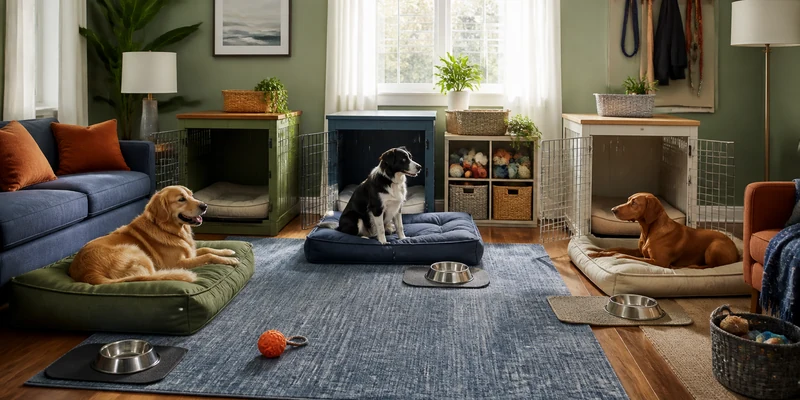
The difference between a chaotic multi-dog household and a calm one is rarely the dogs. It is the setup. Two or more dogs sharing a home are constantly answering small questions: whose bed is that, who eats where, who gets the doorway, where do I go when I have had enough of him. A home that answers those questions with structure, separate beds, managed mealtimes, and a barrier or two in the right places, removes most of the friction before it starts. A home that leaves the dogs to negotiate everything themselves gets to watch the negotiations.
This guide covers the multi-dog household setup room by room: how many of everything you actually need, where separation earns its keep, how size differences change the hardware, and the honest line between what furniture can manage and what belongs with a professional.
Quick Answer
How do you set up a home for multiple dogs?
- One of each per dog: every dog gets his own bed, his own crate or den spot, and his own feeding station, spaced apart.
- Build in separation you can switch on: a gate or pen that lets you split dogs calmly for meals, chews, and cool-downs.
- Furniture manages sharing; it does not fix conflict. Growling over resources that is escalating belongs with your veterinarian and a qualified trainer or behaviorist.
The Multi-Dog Setup at a Glance
Use this as the shopping-and-placement list. The counts are the part most households get wrong, and they are the part that prevents the most trouble.
| Zone | The rule | Why it works |
|---|---|---|
| Beds | One per dog, plus a shared spot if they choose to pile up; never one bed for two dogs | A guaranteed personal spot removes the most common daily competition |
| Crates and dens | One per dog, side by side is fine for friends; never two dogs in one crate | Confinement together removes the exit that keeps sharing voluntary |
| Feeding | Separate stations with real distance, or a barrier between them; pick up bowls after meals | Mealtimes are the most predictable friction point in any multi-dog home |
| Barriers | At least one gate or pen that can split the space calmly | Separation on demand turns tense moments into non-events |
| Chews and toys | High-value chews only in separate spaces; everyday toys can float | Value decides what gets guarded; manage the valuable, relax about the rest |
| Rest and escape | Each dog can reach a spot the others do not follow him into | Most dog-dog tension dissolves when opting out is always possible |
Beds and Dens: One Each, No Exceptions
Dogs who adore each other still need spots that are unambiguously theirs. The working formula is one bed per dog plus one, the extra being a shared big bed or sofa spot for the dogs who genuinely like piling up, and the individual beds being non-negotiable even if they mostly go unused in cuddly households. What you are buying is the option: on the hot day, the sore day, or the fed-up day, every dog has somewhere to be alone that no one contests. Beds do not need to match, and usually should not, since a curler and a sprawler in the same house want different shapes; the matching of bed to sleeper is the whole subject of our dog bed guide.
Crates follow the same one-each rule, with a sharper edge: two dogs closed in one crate is a setup with no exit, and even bonded pairs should be crated separately. Side by side is fine and often comforting. For households that want the crates to look like furniture rather than a kennel row, double furniture-style crates put two dens under one tabletop, covered in double dog crate furniture, with the big-breed version in crate furniture for two large dogs. Size each compartment to each dog with the stand-turn-lie test from how to measure your dog for furniture, because a shared cabinet with one cramped side breeds exactly the resentment you bought it to prevent.
Mealtimes: The Most Predictable Friction Point
Food is where well-matched dogs have their worst moments, and the fix is structural rather than corrective: make mealtimes boring by making them separate. Feed in different corners of the room at minimum, different rooms or opposite sides of a gate when there is any history of hovering or bowl-swapping, and pick up bowls when everyone finishes so there is nothing left to patrol. Fast eaters finishing first and drifting toward slow eaters is the classic sequence, and a barrier between stations removes it entirely.
Speed and size differences make separation more valuable, not less. A small dog on a large dog’s food, or a gulper who then raids the senior’s slow bowl, are management problems that distance solves. High-value extras, the long-lasting chews, stuffed toys, and anything bone-shaped, follow the same logic amplified: hand them out in separate spaces, crates and pens being ideal, and collect them afterward. A dog enjoying a prized chew behind his own door has nothing to guard and no one to guard it from.
Barriers: Separation You Can Switch On
Every multi-dog home eventually needs to split the space: meals, one dog’s crate rest after a veterinary procedure, a visitor nervous of the big one, a new dog integrating slowly, or just two adolescents who need a cool-down. The households that handle those moments calmly are the ones where the barrier already exists and the dogs already treat it as normal.
A dog gate across the right doorway is the workhorse: dogs can see and smell each other through it, which keeps separation low-drama, while the physical question is settled. Open-plan homes and wide spans need the extra-wide formats, and renters can do all of this without a single screw, as covered in dog furniture for renters. A playpen adds a movable room within a room, invaluable for puppies joining adult households, since it lets the residents investigate the newcomer without being ambushed by him.
Mixed-size households get one warning: a gate the small dog fits through is a door, not a barrier. Check bar spacing against the smallest dog, and consider that some gates include a small pet door you can choose to lock or leave open, which in cat-and-dog or big-and-small homes can be a feature rather than a flaw.
Mixed Sizes, Mixed Ages, and the Professional Line
Size gaps change hardware. Beds, crates, and ramps get sized per dog, not per household, and the field guide is the tape measure. The subtler issue is play: a large adolescent and a small senior can both be friendly and still be a bad physical match unsupervised, and a pen or gate that gives the small dog a big-dog-free zone is the kind hardware answer.
Age gaps change routes. A stiff senior sharing a home with young dogs needs his resting spots out of the traffic lanes, first claim on the low-entry bed, and sometimes a gated stair; the full senior-proofing pass is in senior dog mobility at home, and it matters double when younger housemates keep the pace high.
The line furniture cannot cross: setup manages ordinary friction, the hovering, the bowl interest, the occasional grumble that ends the moment distance appears. It does not treat conflict. Escalating guarding, fights that leave marks, a dog who cannot relax when the other is visible, or sudden intolerance between dogs who used to get along are behavioral and sometimes medical signals. Those belong with your veterinarian, to rule out pain and illness, and with a qualified trainer or behaviorist, and going early is cheaper in every currency than going after the third incident.
Common Multi-Dog Setup Mistakes
- One bed for two dogs. Voluntary piling up is fine; enforced sharing is a daily negotiation you imposed.
- Crating dogs together. No exit means no way to opt out. Separate crates, side by side if they are friends.
- Feeding shoulder to shoulder. The most avoidable friction in dog ownership. Distance or a barrier, and bowls up afterward.
- Leaving high-value chews lying around. Value is what gets guarded. Hand out separately, collect afterward.
- Buying one-size furniture for a mixed-size household. Each dog gets measured, each dog gets fitted.
- Using furniture to paper over real conflict. Escalating guarding or fights are a veterinarian-and-behaviorist matter, not a shopping list.
Frequently Asked Questions
How many dog beds do I need for two dogs? Three is the comfortable answer: one per dog plus a shared spot for voluntary piling. The individual beds are the non-negotiable part, even if the dogs usually sleep together.
Can two dogs share one crate? No. Even bonded dogs should be crated separately, because confinement removes the exit that keeps sharing voluntary. Side-by-side crates, or a double furniture crate with separate compartments, give closeness without the risk.
How do I stop my dogs fighting over food? Separate stations with real distance or a gate between them, meals at the same time, and bowls picked up afterward. If guarding is escalating despite managed meals, involve your veterinarian and a qualified trainer or behaviorist.
Do I need a gate for a multi-dog home? Almost certainly. Meals, recovery time, introductions, and cool-downs all go smoother with a barrier the dogs already treat as normal, and see-through gates keep separation low-stress.
How do I introduce a new dog to the setup? Give the newcomer his own bed, crate, and feeding station from day one, use a pen or gate for gradual shared time, and let the residents keep their established spots. Structure makes the integration boring, which is the goal.
What if my dogs have very different sizes? Size everything per dog, check gate bar spacing against the smallest, and give small or senior dogs a zone the heavy players cannot follow them into.
The Bottom Line
A calm multi-dog household is built on counts and switches: one bed, one den, and one feeding station per dog, plus at least one barrier that separates the space on demand. Manage the valuable resources, size the hardware per dog, and make opting out always possible. Furniture handles the ordinary friction; escalating guarding or fighting goes to your veterinarian and a qualified behaviorist, early.