Last updated: August 10, 2026
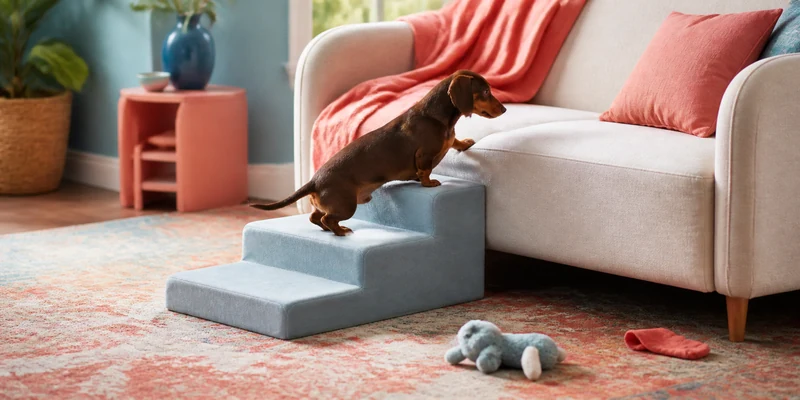
Small dog stairs solve a problem that big-dog owners never see. A couch cushion that a retriever steps onto is shoulder height for a Chihuahua, and the jump down is the small-dog equivalent of you hopping off a wall. Toy and small breeds also carry a specific anatomy issue: fine bones, and in breeds like dachshunds a long back that takes landings badly. For them, furniture access is not a luxury purchase, it is how the couch stays part of their territory for a lifetime.
But most pet steps are built for the average of all dogs, which means step rises sized for legs your dog does not have. This guide covers what actually fits little legs: rise height, step count, soft versus framed builds, and the picks that owners of small breeds consistently stick with.
This article contains affiliate links. If you buy through them, we may earn a commission at no extra cost to you. Learn more.
Quick Answer
What should stairs for a small dog look like?
- Shallow rises, more steps. The single most important spec: each step low enough that your dog walks up in rhythm instead of hopping.
- Soft or padded footing. Foam or padded treads suit fine-boned dogs; hard, slick surfaces are where little paws skid.
- Stability despite the light unit. Small-dog stairs are light by nature, so a non-slip base and snug placement against the furniture do the safety work.
Small-Dog Stairs at a Glance
Use this table as your listing checklist. Everything here can be verified before buying, with a tape measure and a close read of the product page.
| What to check | Why it matters for small breeds | What to look for |
|---|---|---|
| Rise per step | Tall rises force hopping, which many small dogs simply refuse | Low individual steps; at equal total height, always the set with more steps |
| Step count vs. furniture height | Small dogs need the climb broken into more pieces | Three or four steps for a couch, four or five for a bed |
| Tread surface | Light paws slide on smooth fabric and plastic | Textured, carpet-style, or plush gripping covers |
| Edge softness | Fine bones and clumsy dismounts are a bad pairing with hard edges | Foam builds or padded treads on framed sets |
| Base grip and weight | A light unit skids on hard floors when hit at speed | Full non-slip underside, plus a rug or mat beneath on slick floors |
| Width | Narrow is fine for the dog, but tippy if the unit is tall and light | A footprint that looks planted next to the furniture, not tower-like |
| Washable cover | Small-dog stairs live in bedrooms and on carpets | Removable machine-washable covers, standard on good foam sets |
If you are unsure how your dog’s measurements translate to furniture specs, our explainer on how to measure your dog for furniture covers the standing, sitting, and reach numbers worth writing down once.
Why Rise Height Decides Everything
Watch a small dog on people stairs and you see the problem: the dog cannot alternate legs up a rise taller than its own elbow, so it bounds, both front paws up, both back paws follow. That bounding is exactly the jumping motion stairs are supposed to replace, now repeated several times per climb. A step your dog must hop is not really a step for that dog.
The walking test is the standard worth using: on the right stairs, your dog moves up and down in a smooth four-beat walk, head level, no gathering before each step. That typically means low rises and treads deep enough for the whole body during the transition. It is also why the same product can be perfect for a Beagle and wrong for a Pomeranian; always evaluate rise height against your dog, not against the size label on the box.
Our Top Picks for Small Dogs
How we chose: we compared small-breed step sets on rise height, tread depth, surface grip, and how consistently owners of toy and small breeds report willing daily use. Selections rest on manufacturer specifications and recurring review themes rather than our own testing.
If your dog has never used steps, expect a day or two of suspicion; a treat on each tread and a calm first session fix most of it. Forcing never does.
🏆 Best Overall
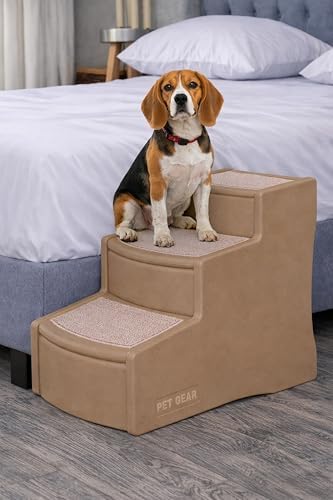
A framed step set designed around a low rise and deep tread geometry specifically for small and older dogs, with a removable washable tread cover. The rare set where the geometry, not just the size label, is small-dog first.

💛 Best Value
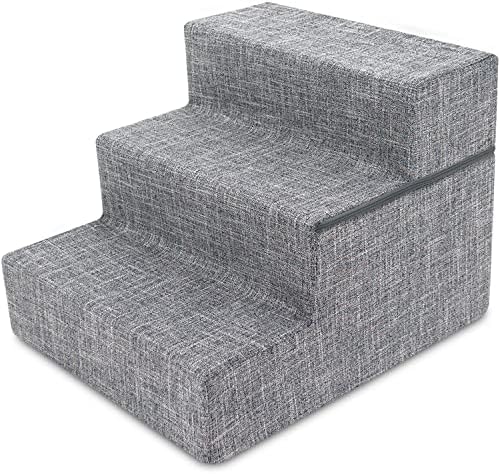
High-density foam steps with a soft washable cover and non-slip base. Gentle footing at a friendly price, and light enough to move wherever your dog needs it that day.
🛏️ Best for Beds
A taller multi-step version with the same shallow-rise approach, for small dogs whose destination is a standard-height bed rather than the couch.
Special Cases: Long Backs, Seniors, and Tiny Puppies
Within the small-dog world, a few groups deserve their own notes.
- Dachshunds, corgis, and other long-backed breeds combine short legs with a spine that handles jumps poorly, which makes furniture access equipment particularly worthwhile. Many of these dogs move more comfortably on a gentle slope than on any staircase; read stairs versus ramp before you commit, and ask your veterinarian what suits your individual dog.
- Small seniors often want both soft footing and the shallowest possible climb. Foam sets shine here, and the broader home adjustments in senior dog mobility at home are worth pairing with the purchase.
- Puppies of small breeds benefit from learning stairs early, but growing joints and reckless energy argue for supervision and low heights first. A cheap foam set for the couch is a sensible starter while you see how your puppy climbs.
For High Beds and Travel
Two situations push past the standard couch set. Tall beds need more total height without taller rises, and small dogs that travel with you appreciate something light and packable.
🐾 Best for High Beds
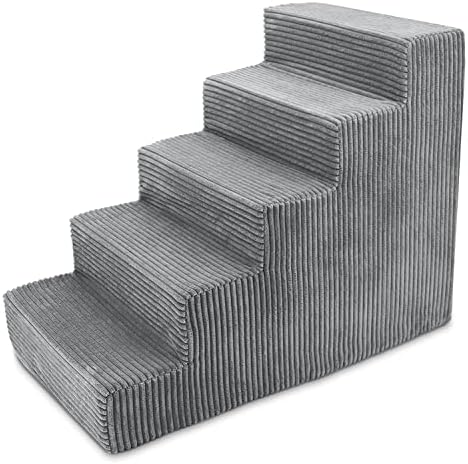
A four-step or five-step foam tower with shallow rises, sized so a small dog reaches a tall mattress in a walk rather than a series of hops. Place it against the bed frame for stability.
🧳 Also Great: Light and Portable
A folding step set that stows flat and travels well, useful for visiting family, cabins, or the RV. Folding builds trade a little solidity for convenience, so check it feels firm once opened.

Setup and Daily Use
Placement rules are the same as for any pet stairs, but the stakes are higher because the unit is lighter. Push the stairs tight against the furniture at the spot your dog already uses, park them on a rug or non-slip pad if the floor is hard, and check they cannot rock or pivot when weight lands on a top corner. A small dog hitting light stairs at a run delivers a surprising shove.
Keep the treads clean and the cover tight after washing, and glance at the geometry monthly on foam sets: the first sign of core fatigue is a top step that stays slightly dished. Small dogs forgive a lot, but a step that moved once under their feet gets remembered.
Common Mistakes with Small-Dog Stairs
- Buying by the “small” label instead of the rise number. Size labels describe the unit, not the geometry. Check inches of rise per step against your dog’s legs.
- Too few steps. Two tall steps to a couch is a hop-hop, not a staircase. More, shallower steps is nearly always the small-dog answer.
- Slick treads. Little paws carry little weight, and low pressure on a smooth surface means low grip. Texture is a requirement, not a finish choice.
- A light unit on a bare floor. The classic failure: dog sprints, stairs shoot backward, dog never touches them again. Anchor light sets every time.
- Ignoring reluctance as stubbornness. A small dog that suddenly refuses stairs it used yesterday may be sore. New avoidance is a veterinarian conversation, not a training problem.
- Skipping stairs because the dog “can make the jump.” Clearing the jump is not the issue; the repeated landings are. The point of steps is what they prevent over years, not what the dog can do today.
Where to Go From Here
If foam sounds like the right build for your dog, the density and cover details in foam dog stairs will keep you away from the sets that slump. If your bed is tall, the height math in dog stairs for high beds applies doubly to short legs. And for the wider view of every construction and size, head back to the hub: best dog stairs.
Frequently Asked Questions
Do small dogs need stairs for the couch? Many benefit from them. The jump down from a couch is large relative to a small dog’s size, and steps replace those repeated landings with a controlled walk. For long-backed breeds especially, owners and veterinarians often prefer managed access over free jumping.
How many steps should small dog stairs have? Enough to keep each rise shallow: typically three or four steps for a couch and four or five for a bed. If your dog hops instead of walks, the rises are too tall regardless of the count.
Are foam or plastic stairs better for small dogs? Foam suits most small dogs thanks to soft footing and forgiving edges, provided the core is high-density. Framed plastic sets win when the stairs take rough use or the dog is at the heavier end of small.
Will my small dog use a ramp more easily than stairs? Some do, especially long-backed, senior, or timid dogs, because a slope removes the stepping motion. The trade-off is floor space; our comparison guide helps you pick per dog rather than per trend.
How do I get my small dog to use the new stairs? Anchor them so they cannot slide, then lure with treats one step at a time over a few short sessions, starting with the bottom step and the dismount. Most small dogs adopt stable, well-sized stairs within days.
The Bottom Line
Stairs for a small dog are bought on one spec above all: rise per step shallow enough that your dog walks instead of hops, with texture underfoot and a base that cannot skid. Foam builds fit most small and senior dogs; framed sets take over for rough use and heavier smalls. Measure your furniture, count the steps, and let the walking test be the judge.