Last updated: August 10, 2026
Searching for dog room ideas usually means one of two things. Either you have a spare room, a corner of the laundry or an alcove you would like to hand over to your dog, or the dog gear has quietly colonized the whole house and you want it gathered in one place that actually looks good. Both are worth doing, and neither requires a renovation budget.
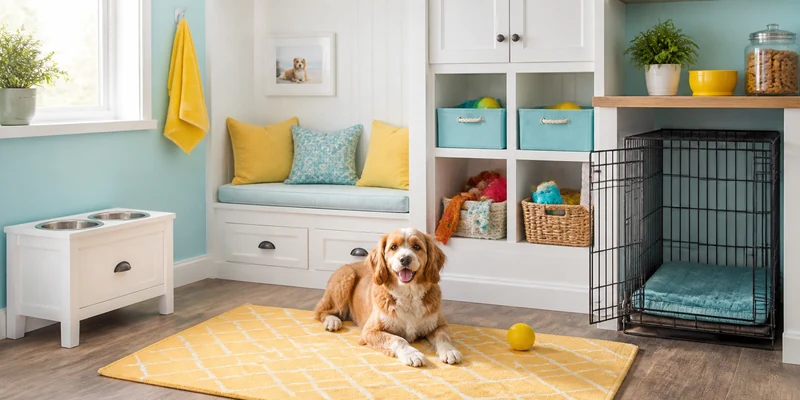
A dog room is really just four functions given a home: sleeping, eating, storage and cleanup. Get those four right and the space works, whether it is a full room or a five foot stretch of wall. This guide walks through the ideas that hold up in daily use, how to pick the right spot, and the details that decide whether your dog actually uses the space you built.
Quick Answer
A good dog room covers four jobs: sleep, food, storage and cleanup.
- Start with the sleeping zone, a crate or bed in a low traffic spot with a view of the household, and build the rest around it.
- You do not need a whole room: an alcove, a closet, an under stairs nook or one wall of a laundry room covers the same four jobs.
- Place it where your dog already wants to be. A perfect room your dog avoids is storage, not a dog room.
Dog Room Ideas at a Glance
Match the idea to the space you actually have, not the space in the photos. Effort here means what it takes to set up, from rearranging furniture to light carpentry.
| Idea | Works best in | Effort | Why it works |
|---|---|---|---|
| Dedicated spare room | Homes with a room to give | Low | Everything in one place, door control for guests and deliveries |
| Laundry or utility corner | Most houses | Low | Hard floors, water nearby, food and gear storage already exists |
| Under stairs nook | Homes with open stair space | Medium | Den shaped by nature, uses space nothing else wants |
| Closet conversion | Apartments, small homes | Medium | Doors come off, bed goes in, shelves above hold all the gear |
| Living room corner | Dogs that follow you everywhere | Low | Keeps the dog with the family, works with furniture style crates |
| Mudroom dog station | Houses with a back entry | Medium | Catches dirt at the door, combines leash, towel and feeding storage |
Two of these have their own full guides: the under stairs dog nook and the dog friendly mudroom. Both go deeper on measurements and build steps.
Start With the Sleeping Zone
The sleeping spot is the anchor, because it is the one part of the room your dog votes on every single day. Get this wrong and the rest of the space is decoration.
Dogs prefer to rest somewhere with a solid wall or corner at their back, a sightline to where the household action is, and no foot traffic passing over them. That is why the crate in the busiest hallway fails and the crate in a quiet corner of the living room succeeds. If the dog room is a separate space, leave the door open or fit a gate so your dog can see out; a den works because the dog chooses it, not because the door closes. For crates specifically, a furniture style crate can double as the room’s main surface, and if you want to know what to look for in one, our dog crate furniture guide covers sizing, ventilation and materials.
Bedding that survives the room
Whatever bed goes in the zone, the cover needs to come off and go in the wash, because a dedicated dog space concentrates hair and smell in one spot. Older dogs benefit from a supportive mattress and a low entry, and if your dog is slowing down, the ideas in senior dog mobility at home are worth folding into the plan before you build.
Feeding, Storage and Cleanup Zones
Once sleep is settled, the other three jobs are mostly about containment.
- Feeding. Bowls belong on hard flooring with a washable mat, away from the walkway. Raised feeders with built in storage keep the kibble bag out of sight, and a sealed container matters more than any styling choice, both for freshness and for pest control.
- Storage. One hook per leash, one bin per category: towels, toys, grooming, medication. Wall hooks at adult height, closed storage for anything your dog considers edible. The pile by the front door disappears the week you give everything one assigned place.
- Cleanup. A towel within arm’s reach of the door, a mat that catches paws, and a lidded bin for waste bags. If the room has a floor drain or sits next to a bathroom, a dog washing setup becomes realistic, which is the main argument for the mudroom version of this project.
Flooring, walls and light. Hard surfaces beat carpet everywhere a dog eats, drinks or dries off. A washable paint finish on the lower third of the wall earns its keep, and dogs use a room with a window far more readily than a dark one. None of this requires renovation: a large washable rug over existing floors solves most of it in a rental.
Making It Look Like Part of Your Home
The difference between a dog room that looks intentional and one that looks like a kennel is mostly repetition and restraint. Pick one wood tone and one accent color, and let every piece in the space follow them. Match the storage to furniture you already own rather than buying a pet themed set. Keep the floor clear: gear on walls and in cabinets, only the bed and bowls at dog level.
This is where the design led end of the market earns its place, since a crate that reads as an end table or a console lets the dog zone sit inside a finished room instead of apart from it. The modern dog furniture guide shows what that looks like piece by piece, and dog crate in the living room covers the most common version of the problem: making the crate belong in the room everyone actually uses.
Common Mistakes When Setting Up a Dog Room
- Building it where you want the dog, not where the dog wants to be. A dog that sleeps outside the bedroom door will not adopt a beautiful room at the far end of the house. Watch where your dog already settles and claim that spot.
- Treating it as banishment. If the room only appears when guests arrive or the dog is wet, it becomes a signal, not a sanctuary. Feed there, hide treats there, let good things happen there.
- Skipping the door plan. Decide early whether the space needs a gate, a door or nothing. Retrofitting a gate into an opening that was never measured for one is the most common redo.
- Carpet under the water bowl. The one flooring decision that always gets regretted. Hard surface or washable mat, no exceptions.
- Buying the gear before measuring the dog. Crate, bed and nook dimensions all start from your dog stretched out, plus growing room for a puppy. Measure first, shop second.
Where to Take This Next
If your space points at a specific version of this project, go straight to the dedicated guide: the under stairs nook build for homes with open stair space, or the mudroom setup if the back entry is where your dog’s day starts and ends. In a multi dog household, the room plan changes more than most people expect, and the multi dog setup guide covers who needs their own zone and who can share.
Frequently Asked Questions
Does a dog room need to be a whole room? No. The four jobs, sleeping, feeding, storage and cleanup, fit along one wall of a laundry room, in a converted closet or under the stairs. The dedicated room version is a luxury, not a requirement.
Where is the best place in the house for a dog room? Close to the household’s daily activity, with hard flooring and ideally a window. Dogs use spaces they can see the family from, which is why laundry rooms off the kitchen and living room corners work so well.
Should the dog room have a door that closes? A gate usually beats a closed door, because most dogs settle better when they can see out. Save the closing door for situations that need it, like contractors or reactive moments, rather than daily use.
What flooring is best for a dog room? Anything hard and washable: tile, vinyl plank, sealed concrete. In a rental, a large washable rug over the existing floor does the same job without touching the lease.
How do I get my dog to actually use the room? Put the bed where the dog already naps, feed meals in the space, and keep the door or gate open at first. If the room only ever means separation, the dog learns to avoid it.
The Bottom Line
A dog room is four functions with an address: a sleeping zone your dog chooses, feeding on a washable surface, storage with assigned places and cleanup at the door. It can be a spare room, a closet, a nook or one well organized wall, as long as it sits where your dog already wants to be. Anchor it with the sleeping spot, keep the palette consistent with the rest of your home, and add the extras only after the routine proves what is missing.