Last updated: August 10, 2026
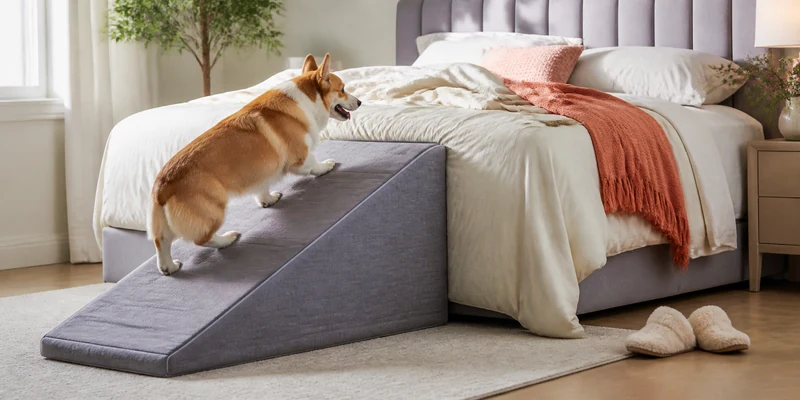
A dog ramp for the bed is usually bought for one of two dogs: the senior who still sleeps against your legs but has quietly stopped making the jump, or the dachshund-shaped dog whose owner has read enough about long backs to want the jumping career over early. Either way, the bedroom is where furniture access matters most, because it is the one climb your dog makes every night and every morning, year after year.
Bedside ramps are their own species: unlike car ramps they stay deployed around the clock, they need to fit along a wall or bed frame without ruling the room, and they reach higher than couch-height gear. This guide covers how to pick one that your dog uses unsupervised at 3 a.m., which is the actual job description.
This article contains affiliate links. If you buy through them, we may earn a commission at no extra cost to you. Learn more.
Quick Answer
What makes a good bed ramp for a dog?
- Height that matches your mattress and length enough to keep the slope a relaxed walk; along the side of the bed is usually where that length fits.
- A freestanding, planted build: the ramp works alone at night, so it cannot depend on you holding or checking it.
- Carpet-style traction and quiet footing, because this ramp gets used barefoot-hours of the day and shares your bedroom.
Bed Ramp Checklist
Measure floor to mattress top with bedding compressed, then take that number to this table.
| What to check | Why it matters at the bedside | What to look for |
|---|---|---|
| Top height | A ramp ending below the mattress leaves a ledge at the worst spot | A stated top height at or within an easy step of your mattress top |
| Length and slope | Bed heights are the tallest indoor climb; short ramps get steep | The longest ramp the bedside wall allows; gentler is always safer |
| Freestanding stability | It must hold with no one supervising | A rigid frame with a wide stance that cannot tip or fold in use |
| Walking surface | Night use means sleepy dogs and low light | Carpeted or textured tread, ideally removable for washing |
| Footprint in the room | The ramp lives deployed, day and night | A slim profile that runs along the bed rather than into the walkway |
| Base grip | Hardwood bedrooms plus a running dog equals a sliding ramp | Non-slip feet plus a rug or pad under the base |
| Weight capacity | Flex mid-span makes cautious seniors quit | A stated capacity comfortably above your dog’s weight |
If your mattress is unusually tall, read this guide together with dog stairs for high beds; past a certain height the two categories are competing for the same job, and the right answer depends on your dog and your floor space.
Why Ramps Win in the Bedroom
The bed is the tallest thing most dogs climb daily, and the descent is the half that matters: a dog leaving a high mattress lands with the force concentrated on the front legs, in the dark, often half asleep. Stairs help, but they still ask for a precise stepping motion at height. A ramp removes the motion entirely, which is why it is the standard recommendation for long-backed breeds, seniors, small dogs facing a proportionally huge drop, and dogs working through recovery periods where a veterinarian has asked for no jumping.
The trade-off is space: to keep a bed-height slope gentle, the ramp needs real length, and the elegant way to get it is to run the ramp along the side of the bed instead of out into the room. That layout also matches how dogs approach the bed, in a line along your side of it, and it leaves the walkway clear. Owners of hesitant dogs report the along-the-bed layout works better for another reason too: a wall of mattress on one side acts as a natural rail.
Our Top Picks for Beds
How we chose: we compared indoor ramps on top height, slope at typical bed heights, freestanding stability, tread surface, and how consistently owners of senior and long-backed dogs report unsupervised nightly use. Selections rest on manufacturer specifications and recurring review themes rather than hands-on testing of our own.
Expect a settling-in week: even ramp-experienced dogs need a few guided trips before the 3 a.m. solo runs begin. The sequence in teaching your dog to use a ramp shortens it.
🏆 Best Overall
A freestanding bedside ramp in solid hardwood with side rails and a non-slip surface, adjustable across bed heights. Built for exactly this job: deployed permanently, used unsupervised.

💛 Best Value
An adjustable-height freestanding ramp with a traction tread, so one unit can serve the couch now and the bed later. The flexible pick if the destination might change.

🐕 Best for Hesitant Dogs
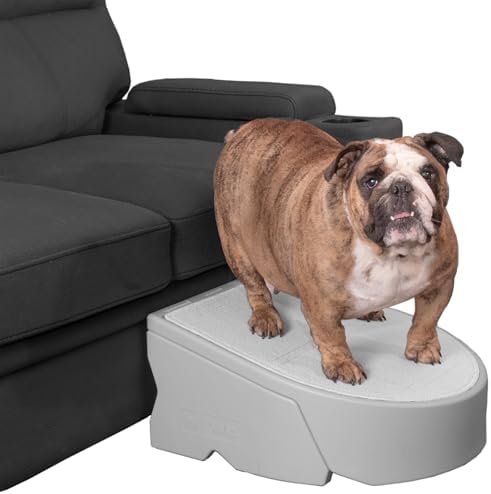
A stair and ramp hybrid with broad, shallow tiers that gives a continuous walking line without a full ramp’s length. A good middle path for dogs that distrust slopes and beds that sit moderately high.
Matching the Ramp to Your Dog
The bedside case varies more by dog than by bed, so here is how the usual suspects sort out.
- Long-backed breeds such as dachshunds and corgis are the textbook bed-ramp dogs: short legs, proportionally huge bed heights, and spines that reward avoided jumps. Go gentle on slope and generous on tread grip, and involve your veterinarian early if your dog already shows back trouble.
- Senior dogs need the gentlest slope you can fit and lighting they can navigate; a nightlight near the ramp base is a cheap upgrade. The rest of the aging-dog room setup is covered in senior dog mobility at home.
- Small dogs often prefer ramps to tall staircases simply because a bed-height stair tower feels exposed; a slope with the mattress alongside reads as safer.
- Large seniors are the hardest fit: they need width, stiffness, and capacity, and the ramp must still fit the room. Shop the heavy end of the freestanding market and hold the line on slope.
- Recovering dogs under jump restrictions should use whatever their veterinary team recommends; a ramp is commonly part of that plan, and a gate at the bedroom door can keep an unsupervised dog off the bed entirely when required.
If the Bedroom Cannot Fit a Ramp
Sometimes the honest answer is that the room is too tight for a walkable slope. Two ways out are worth naming. Stairs trade slope for footprint, and a shallow-rise set may fit where a ramp cannot; the tall-bed staircase options live in dog stairs for high beds. The other route is lowering the destination: a genuinely supportive dog bed on the floor beside yours removes the climb entirely, and for a stiff senior that can be the kinder arrangement. Our orthopedic dog bed guide covers what actually makes a floor bed supportive rather than just thick.
🐾 Also Great: Compact Bedside Steps
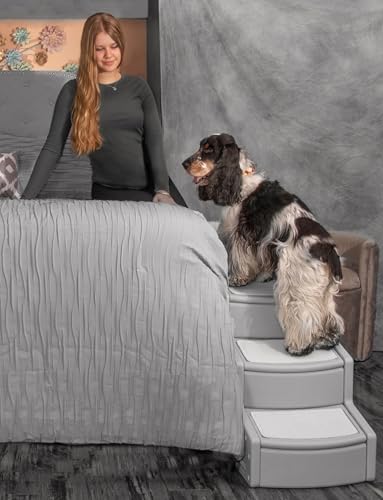
A tall shallow-rise step set for bedrooms where a full-length ramp will not fit. Not a slope, but the next best thing at bed height for a dog that steps confidently.
Placement and the Nightly Routine
Run the ramp along the bed on the side your dog sleeps, top edge tight to the mattress with no gap a paw could find in the dark. Anchor the base on a rug or non-slip pad, and check the frame cannot walk away from the bed over a week of use; a strip of grippy furniture pad between ramp and bed frame quietly fixes most migration. Leave the approach clear: a ramp that ends behind a laundry basket does not exist as far as the dog is concerned.
Then make it boring, which is the goal. Guide the first descents on leash or by collar hand, reward calm walking, and block the old launch spot with a pillow for the transition weeks. When the ramp is the path of least resistance in both directions, the habit holds on its own.
Common Mistakes with Bed Ramps
- Buying couch height for a bed job. Check the stated top height against your mattress; an under-tall ramp rebuilds the ledge it was meant to remove.
- Pointing the ramp into the room. Along the bed is nearly always the better layout: gentler-feeling, space-saving, and self-railed by the mattress.
- Tolerating a wobble. An unsupervised night ramp has no margin for a loose frame. If it rocks, fix it or return it.
- Slick floors under the base. The classic first-week failure. Pad first, then introduce the dog.
- Removing the jump option too abruptly. Block the old launch spot gently and reward the ramp; a dog forced cold onto a strange slope learns to avoid it.
- Reading refusal as preference. A dog that suddenly will not come up at all may be sore, not stubborn. New reluctance at the bed is a veterinarian conversation.
Where to Go From Here
If you are still weighing slopes against steps for the bedroom, the decision logic in dog stairs or ramp applies most sharply at bed height. The wider ramp world, including vehicle models for the same aging dog, lives in the hub at best dog ramp. And because the ramp and the mattress work as a set for a senior, the sleeping-surface half of the equation is in best orthopedic dog bed.
Frequently Asked Questions
Are ramps or stairs better for a bed? For seniors, long-backed breeds, and recovery periods, a ramp is usually the better bedside tool because it removes the stepping motion at the tallest indoor height. Stairs win when floor space is the binding constraint; see the full comparison.
How long should a dog ramp for a bed be? Long enough that the slope to your mattress top is a relaxed walk, which at typical bed heights means the longer end of the indoor market, run along the side of the bed. Gentler always beats shorter.
Will my dog use a bed ramp at night? Yes, once it is stable, gently sloped, and established as the routine, which takes most dogs under two weeks of guided use. A nightlight near the base helps older dogs commit in the dark.
Do bed ramps work for large dogs? Good freestanding models with a high stated capacity do, provided the deck does not flex and the slope stays gentle. Width matters too; a big dog needs room for a natural gait.
My dog uses the ramp up but jumps down. Is that a problem? The descent is exactly where the landing load lives, so it is the half worth fixing. Block the launch spot temporarily and reward walked descents; if the jumping continues out of habit, a few leash-guided exits usually reset it.
The Bottom Line
A bed ramp is bought on three requirements: top height that truly reaches your mattress, length enough for a gentle slope along the bedside, and a freestanding build stable enough to work unsupervised at night. Carpet-style traction, an anchored base, and a patient first week do the rest. For the dogs that need it most, seniors and long-backed breeds, it is the single most-used piece of pet furniture in the house.