Last updated: August 10, 2026
A large elevated dog bed has a harder job than the small ones. An eighty pound Lab does not lower himself onto a cot, he drops onto it, usually after a running start, and the sideways shove when he jumps off again is what bends cheap frames and rips fabric out of its channels. The cots that survive big dogs are built differently: thicker legs, reinforced corners, sometimes a center support bar, and a panel that stays taut instead of turning into a hammock.
The good news is that this is one of the categories where big dogs benefit most. Heavy, thick-coated breeds run hot, and a breathable panel with air moving underneath solves the overheating problem that a slab of foam makes worse. This guide covers what actually makes a cot large-dog-proof, which sizes and capacities to look for, and our picks for dogs who break ordinary beds.
This article contains affiliate links. If you buy through them, we may earn a commission at no extra cost to you. Learn more.
Quick Answer
What makes an elevated bed work for a large dog?
- Capacity with margin: choose a stated weight limit well above your dog’s actual weight, because a jumping dog loads the frame far harder than a resting one.
- Size by measurement, not by label: your dog stretched out on his side, nose to base of tail, must fit inside the panel dimensions with room to spare.
- Frame first, fabric second: steel or aluminum legs, reinforced corners, and a taut panel matter more for big dogs than any comfort feature.
Large Elevated Dog Beds: What to Check Before You Buy
Big dogs expose weaknesses that small dogs never find. Run any cot you are considering through this checklist, in this order.
| Check | What you want to see |
|---|---|
| Stated weight capacity | A number comfortably above your dog’s weight, with room for a second dog if they pile on together |
| Panel dimensions | Longer than your dog measured nose to tail base while lying stretched out, plus several inches |
| Frame material | Powder-coated steel or aluminum; PVC pipe frames flex too much under heavy dogs |
| Center support | On wide XL formats, a cross bar or reinforced mid-span that stops the long sides bowing inward |
| Fabric attachment | Fabric wrapped into channels or secured under rails, not stapled or exposed at the corners |
| Feet | Rubber or capped feet that grip hard floors when the dog launches off |
| Replaceable panel | Covers sold separately, because the fabric wears out years before a good frame does |
If you are new to the category and want the full background on formats and fabrics first, start at our elevated dog bed hub guide and come back here for the size-specific decisions. Measuring properly takes two minutes and prevents most returns, and we walk through it step by step in how to measure your dog for furniture.
Why Big Dogs Break Ordinary Cots
The failure is almost never the fabric tearing in the middle. It is the structure around it giving way, in one of three predictable places.
The corners. Most cot fabric is tensioned at the corners, so that is where the stress concentrates every time a heavy dog lands. On budget cots the fabric pulls out of its channel or the corner joint cracks. Better large-dog cots wrap the fabric fully into the frame or cap the corners in metal, leaving no starting point for stress or, usefully, for teeth.
The mid-span. A wide panel with a heavy dog in the middle of it pulls the two long rails toward each other. Over months this turns a taut cot into a sagging sling, which loses the airflow and the flat support that justified the purchase. A center support bar or thicker rail stock is the fix, and it is the clearest visible difference between a standard cot scaled up and a cot engineered for large breeds.
The joints. Legs that press-fit into plastic corner blocks work loose under repeated impact. Bolted metal joints last. Push down hard on the middle of the assembled bed and rock it corner to corner: anything that creaks or flexes noticeably under your hands will fail faster under a dog who outweighs a load of laundry.
Heavy dogs who are also dedicated chewers compound all of this, because a slightly lifted corner edge becomes an invitation. If your dog has already eaten a bed or two, skip ahead to the armored end of the market via our chew proof dog bed guide.
Our Top Picks for Large Dogs
How we chose: we compared widely available large and XL elevated beds on stated weight capacity, frame construction, corner and mid-span reinforcement, and durability themes in owner reviews of big-breed households. Selections are based on manufacturer specifications and owner reporting, not hands-on testing.
Sizes are not standardized between brands, so treat Large and XL as marketing labels and compare the actual panel dimensions against your dog’s stretched-out length.
🏆 Best Overall
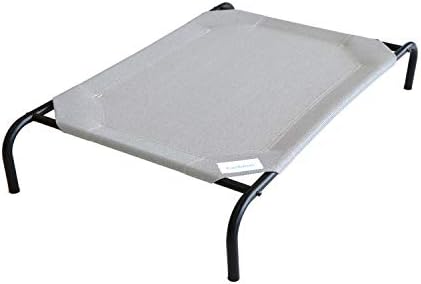
The large size of the classic knitted-mesh cot, with the breathable HDPE fabric and steel frame the brand is known for, plus replacement covers sold separately. The default choice for big dogs who are not destructive.
💪 Best Heavy-Duty
An aluminum-framed chew-resistant cot in XL, with rip-stop style fabric secured so there are no exposed edges. Built for the heavy dogs who have already retired a standard cot, and backed by a chewer-focused warranty.

💛 Best Value
A straightforward steel-frame mesh cot in the largest size, at a price that makes it easy to try elevated sleeping before committing to a premium frame. Fine for calm large dogs; not the pick for launchers and chewers.

Sizing an Elevated Bed for a Big Dog
Get the length right and everything else follows. Measure your dog lying on his side, fully stretched, from nose to the base of the tail, and add a handful of inches. That number needs to fit inside the panel, not the overall frame, because the frame dimensions in listings include the rails your dog cannot actually lie on.
Giant breeds sit at the awkward top of the market. A Great Dane or a Newfoundland outruns many XL panels, and two options remain: the small number of XXL cots built with center supports, or accepting that the dog will drape a paw or a head off the edge, which many big dogs do by choice anyway. What you should not accept is a dog whose hips or shoulders land on the rail when he lies down naturally, since that is the fastest way to teach him the bed is uncomfortable.
Height matters at the other end of the dog’s life. Most cots stand 6 to 9 inches tall, trivial for a healthy adult, but a large senior with stiff joints steps rather than hops, and a wobbling entry will put him off. For older big dogs, a rock-solid frame is not a luxury, and if your dog has recently started hesitating at heights he used to ignore, that change belongs in a conversation with your veterinarian. Our guide to senior dog mobility at home covers how to read those signals around the house.
One More Option Worth a Look
If your big dog wants elevation and padding, there is a middle route between the cot and the mattress.
👍 Also Great
A large-format pet cot from a long-standing brand in the category, with a taut supportive panel and simple assembly. A dependable alternative when the top picks are unavailable in the size your measurement calls for.

And if what your large dog actually needs is pressure relief rather than airflow, a supportive foam mattress is the better tool for the job. Thick, dense foam bases built for heavy dogs are their own category, covered in our guide to the orthopedic dog bed for large dogs. Plenty of big-dog households run a cot for summer and a foam bed for winter, and let the dog vote with his feet.
Setup and Everyday Use With a Heavy Dog
Assemble on a flat floor and get the panel drum-tight before the last leg or rail goes in, because a panel that starts loose only gets looser under an eighty pound load. Recheck every joint after the first week, then monthly; large-dog cots live a harder life and hardware backs out under repeated impact.
Placement follows the same rules as any dog bed, with one addition: give a big dog a run-off zone. Large dogs dismount forward with momentum, and a cot with a coffee table or a tile step directly in the landing path is asking for a collision. Against a wall, sightline to the room, nothing breakable within a body length of the exit side.
Cleaning is where the format pays you back. Hose the mesh, wipe the frame, vacuum underneath, done. In hot months check the panel tension more often, since heat and load together are what relax fabric, and a mid-panel sag is your early warning that the cot is aging out.
Common Mistakes to Avoid
- Buying at the weight limit instead of above it. Ratings assume a resting load. A jumping dog is not a resting load.
- Trusting size labels. One brand’s XL is another brand’s Large. Compare panel dimensions against your measured dog, every time.
- Choosing a PVC frame for a heavy dog. Light frames flex, joints work loose, and the cot ends up wobbling within months.
- Ignoring the mid-span. Wide panels without center support turn into hammocks under big dogs, and a hammock defeats the point of a cot.
- Forgetting the second dog. In multi-dog homes, two dogs on one cot is common and doubles the load. Either buy capacity for both or buy two beds, a decision we unpack in multi-dog household setup.
Frequently Asked Questions
What size elevated bed does a large dog need? Measure the dog stretched out on his side from nose to tail base and add a few inches, then compare that against the panel dimensions rather than the overall frame size. When you land between two sizes, go up.
How much weight can an elevated dog bed hold? It varies widely by model, which is exactly why the stated capacity matters. Choose a rating comfortably above your dog’s weight to allow for the impact of jumping on and off.
Are elevated beds good for large breeds that overheat? They are one of the better tools for it. Air moving under a breathable panel carries heat away, which is why thick-coated and heavy breeds are the category’s most enthusiastic users in summer.
Will an elevated bed sag under a heavy dog? A well-built one with a taut panel and reinforced rails should not sag meaningfully for a long time. Persistent mid-panel sag means the fabric needs replacing or the cot was underbuilt for the dog.
Is a cot or a foam bed better for a big older dog? They solve different problems: cots handle heat and cleaning, supportive foam handles pressure on joints and an easier lie-down. Many seniors do best with a low, supportive foam bed, covered in our large-dog orthopedic guide, and any new stiffness belongs at the veterinarian first.
The Bottom Line
A large elevated dog bed lives or dies on its structure: capacity above your dog’s weight, a steel or aluminum frame, reinforced corners, and a panel long enough for the dog you measured rather than the breed you own. Get those four right and a cot gives a big dog years of cool, clean, supportive sleeping. Chewers should go straight to the armored builds, and seniors may be better served by low supportive foam.