Last updated: August 10, 2026
Crate training in a furniture crate sounds like it should be identical to crate training in a wire crate, and it almost is. The difference is what is at stake: a wooden cabinet is a piece of furniture your dog can damage, an investment you cannot fold flat and store, and usually a fixture in your most visible room. Training mistakes that a wire crate forgives, a furniture crate remembers in tooth marks.
The good news is that the furniture format also helps you. A crate that lives beside the sofa, in the middle of family life, is far easier to make appealing than a cage in the laundry room. This guide walks through the training sequence step by step, what changes because the crate is wooden, and the mistakes that cost people their cabinets.
Quick Answer
How do you crate train a dog in a furniture crate?
- Same method as any crate: open door, food and treats inside, duration built up gradually, never used as punishment.
- The furniture twist: prove calm crate behavior first, ideally in a cheap wire crate, before the dog moves into wood it can damage.
- Placement is your advantage: a crate inside the family circle, door open all day, becomes the dog’s chosen spot faster than any isolated cage.
The Step-by-Step Plan
Work through these stages in order, moving on only when the current one looks easy for your dog. Fast dogs clear the list in days, cautious dogs in weeks, and both are normal.
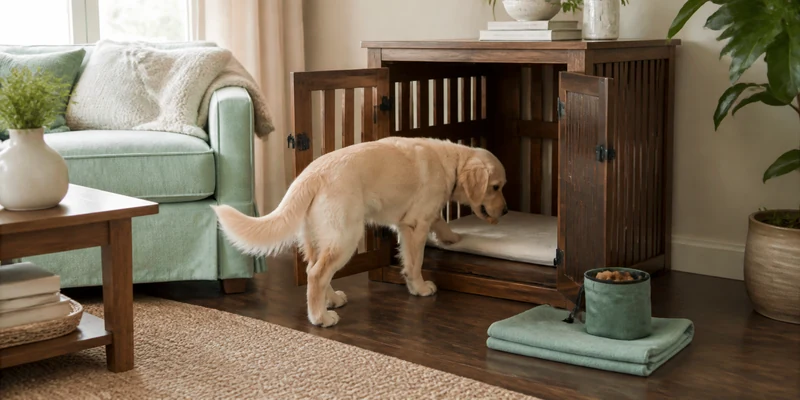
- Stage the crate. Put the furniture crate in the room where the household actually lives, against a wall, with comfortable bedding inside and the door fixed open so it cannot swing and startle.
- Make the crate produce good things. Toss treats inside for the dog to find, feed meals just inside the door, then deeper in. Say nothing, force nothing; let the cabinet become a treat dispenser.
- Name it and reward entries. When the dog steps in on its own, mark it with a cheerful word and a treat. Add a cue like “crate” or “bed” once entries are frequent.
- Close the door briefly. First with you sitting right there, for seconds, then a minute, then several, always opening before the dog fusses. A stuffed chew toy makes closed-door time pleasant.
- Add distance and duration. Step out of sight for moments, return calmly, extend gradually. Undramatic departures and returns are the entire trick.
- Build to real absences. Short errands first, then longer stretches appropriate to the dog’s age and bladder, with a walk before and calm greetings after.
- Keep the door open by default. Once trained, the crate should be the dog’s free-access den, closed only when needed. That is when a furniture crate earns its living-room address.
What Changes Because the Crate Is Furniture
First, sequencing. A wooden cabinet is the graduation venue, not the training ground. If your dog has never been crated, or crates badly, do the noisy early work in an inexpensive wire crate and move to the furniture piece once calm, settled behavior is routine. A dog that paws, chews, or rattles doors in week one will do it to veneer and mesh instead of steel, and the repair bill lands on your end table. What to look for when you do buy the wooden piece is covered in our guide to dog crate furniture.
Second, the environment works for you. Furniture crates live where the family is, and dogs are social sleepers: the same animal that cried in a utility-room cage will often drift voluntarily into a den positioned beside the sofa. Use that. Keep the door open all day, let naps happen there naturally, and the crate stops being an event and becomes an address. The room-placement details, sightlines, drafts, and traffic, are the subject of our piece on the dog crate in the living room.
Third, the material sets a few house rules. No loose water bowls on a wooden floorpan, chew toys that are more interesting than the frame, and a washable mat over the crate floor during the housetraining months so accidents never meet bare board.
Reading Your Dog Along the Way
Progress looks like this: entering without hesitation, settling with a sigh rather than pacing, choosing the crate for naps with the door open, and staying relaxed when the door first closes. When you see those signs, the current stage is done and the next can start.
Stalls are information, not failure. A dog that plants at the threshold needs more open-door treat history; a dog that fusses the moment the door closes needs shorter closures with you nearby; a dog fine alone for one hour but destructive at three has hit its current ceiling, so back up and rebuild more slowly. And a dog that panics, drools heavily, injures itself, or destroys the crate interior when left is not being stubborn, it is distressed. Stop crating unattended and talk to your veterinarian or a qualified trainer, because separation distress does not train away with a better cabinet.
Fitting the Crate Into the Household Routine
Anchor the crate to the day’s rhythm. Meals in the crate keep the good-things association alive permanently. A pre-crate walk means the dog enters tired and empty; a calm exit ritual, out, greet quietly, straight outside, protects the housetraining. Guests, deliveries, and vacuum sessions become chances to send the dog to its den with a chew rather than managing chaos, which is exactly the everyday value crate-trained households rave about.
Size and comfort carry more of the load than people expect: a dog can only settle in a crate it can stand, turn, and stretch in, so verify fit with the routine in how to measure your dog for furniture before blaming the training. Bedding should be washable and snug; in multi-dog homes, each dog gets its own den and its own door, never a shared obligation.
Common Mistakes to Avoid
- Using the crate as punishment. One angry time-out can undo weeks of treat history. The den only ever produces good things.
- Rushing the door stage. Closing the door for an hour on day two creates the protest habits that damage wood. Seconds first, minutes later.
- Buying furniture before behavior. The cabinet is the reward for a trained dog, not the tool that trains it.
- Dramatic hellos and goodbyes. Big emotional departures teach the dog that alone-time is a crisis. Be boring.
- Leaving the dog crated too long. Puppies especially have short limits. Duration follows age and bladder, whatever the crate looks like.
- Ignoring distress signals. Escape attempts and heavy drool are welfare flags, not training challenges. Get professional help.
Ready for the Next Step?
Once the training holds, the furniture questions get fun. If you are still choosing the cabinet itself, our hub on dog crate furniture walks through sizes, materials, and latches, and see what to look for in a small-format crate in small dog crate furniture if your trainee is pocket-sized. For making the den a genuine part of the room rather than a tolerated box, dog crate in the living room covers layout and styling.
Frequently Asked Questions
Can I crate train directly in a furniture crate? With a calm adult dog or a placid puppy, yes, using the same gradual steps. With energetic puppies and rowdy adolescents, prove the behavior in a wire crate first, since the destructive early phase is exactly what wooden cabinets do not forgive.
How long does crate training take? Anywhere from a few days to several weeks, depending on the dog’s history and temperament. The pace is set by the dog clearing each stage calmly, not by the calendar.
Where should the furniture crate go during training? In the room where the household spends its time, against a wall, out of drafts and direct sun. Isolation is the classic training killer; company is the furniture crate’s superpower.
My dog chews the crate frame. What now? Provide a crate-only chew that outranks the frame, shorten crated stretches, and add exercise. If chewing happens only when you leave, treat it as possible separation distress and involve your veterinarian or a trainer before continuing.
Should the crate door be open or closed at home? Open by default once training holds. The goal is a den the dog chooses freely, with the door closed only for meals apart, guests, travel prep, or rest enforced after veterinary advice.
The Bottom Line
Crate training in a furniture crate is standard crate training with the order of operations enforced: behavior first, furniture second, and the cabinet placed where family life happens. Build the den association with food and patience, grow the closed-door time gradually, and keep the door open as the default once it holds. Do that, and the wooden crate becomes the one piece of dog gear your living room is better for.