Last updated: August 10, 2026
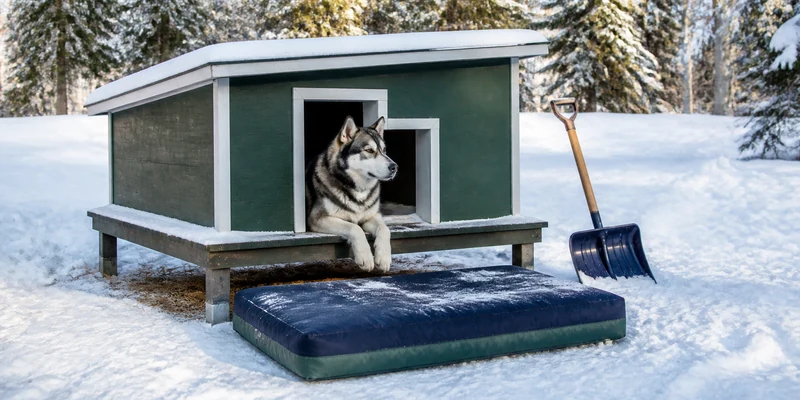
An outside dog house for winter has one job that a summer shelter does not: holding a pocket of your dog’s own warmth against cold, wind, and damp for hours at a stretch. That job is won or lost on details that never show up in product photos, wall construction, doorway design, what the floor sits on, and what the bedding is made of. A midrange house set up well will outperform an expensive one dropped straight onto frozen ground with a blanket inside.
This guide covers the whole winter equation: which houses are built for cold, the setup steps that multiply their effect, when to add safe supplemental heat, and the honest limits, because no product makes severe cold safe for an outdoor dog.
This article contains affiliate links. If you buy through them, we may earn a commission at no extra cost to you. Learn more.
Quick Answer
What makes a dog house work in winter?
- Four features carry the load: thick or insulated walls, a small wind-protected doorway with a flap, a floor raised off the ground, and deep straw bedding.
- Size it snug. The house warms up from your dog’s body heat, and an oversized interior never does.
- For long hard freezes, add an outdoor-rated heated pad with a thermostat and safety listing. Never heat lamps or human heaters, and in severe cold, bring the dog inside.
The Winter Checklist at a Glance
Every item below moves the needle on its own; together they are the difference between a shelter and a refuge. Use this as your buying and setup checklist.
| Element | What good looks like | Why it matters |
|---|---|---|
| Walls | Double-wall, insulated panel, or thick structural foam | Slows the loss of body heat through the shell |
| Size | Stand, turn, stretch out, small headroom, no more | Less air volume means the chamber actually warms |
| Doorway | Small, offset or shielded, flexible flap fitted | The opening is the biggest heat leak in any house |
| Floor | Raised on blocks, pavers, or a pallet | Stops ground contact draining heat and wicking damp |
| Bedding | Deep straw, refreshed when flat or musty | Insulates underneath; stays dry where fabric freezes |
| Ventilation | Small vent high in the house, kept clear | Lets breath moisture out; airtight means damp |
| Placement | Door away from prevailing wind, near a windbreak | Wind strips heat faster than still cold air |
| Heat (optional) | Outdoor-rated pad, thermostat, listed, protected cord | Safe warmth for hard freezes and cold-sensitive dogs |
If your current house fails several rows of that table, you may not need a new one: the step-by-step guide on how to insulate a dog house shows how to retrofit most of these features onto an existing shell.
Choosing the House: What Winter Demands
Construction first. In winter the wall is a battery for your dog’s body heat, so thin single-wall shells are out. The proven options are thick structural foam domes like the igloo shape, double-wall plastic houses, insulated-panel composites, and well-built solid wood. Each is covered in depth in the insulated dog house guide; the short version is that enclosed construction beats any particular material, and any foam must be sealed away from teeth.
Shape and entry matter almost as much. A dome or a house with an offset entry keeps wind off the sleeping area, which is why the igloo dog house remains the cold-climate default. In a conventional box, look for a doorway positioned to one side rather than centered on the sleeping wall, and treat a door flap as mandatory rather than an accessory. Sizing follows the usual rule, snug over spacious; our measuring guide shows how to check your dog against interior dimensions.
Our Winter Picks
How we chose: we compared cold-weather dog houses and accessories on wall construction, entry protection, floor design, available sizes, and recurring themes in owner reviews from cold-climate buyers. Selections are based on manufacturer specifications and owner feedback, not hands-on assessment.
These three cover the core setup: a proven house, its warmth upgrade, and the safe heat source for when insulation alone stops being enough.
🏆 Best Overall
The igloo-style benchmark: thick structural foam walls, a wind-blocking tunnel entry, top vent, and a raised, channeled floor. The strongest passive cold-weather design on the market, in multiple sizes.

🐾 Best Heavy-Duty for Large Dogs
A double-wall high-density plastic house with real interior height for big breeds and panels that shrug off snow and rough handling. Pairs well with DIY insulation upgrades.

❄️ Best for Hard Freezes
An outdoor-rated heated bed with a thermostat, low wattage, a steel-wrapped cord, and an independent safety listing. The safe way to add real warmth inside any of the houses above.

Setup: Placement, Elevation, and Bedding
Pick the spot before winter arrives. The doorway should face away from the prevailing wind, which in much of the US means east or south, and the house benefits enormously from a windbreak: a wall, a fence line, a hedge, or the leeward side of a shed. Avoid low spots where meltwater collects, and make sure drainage runs away from the entrance, not toward it.
Then get the floor off the ground. Blocks, pavers, or a pallet create an air gap that stops the soil pulling heat out through the floor and moisture wicking in. A few inches is enough. Inside, lay straw deep enough for the dog to nest into, and plan to refresh it several times over the season, whenever it flattens, dampens, or smells musty. Skip blankets, towels, and hay: fabric holds moisture and freezes stiff, and hay stays damper and molds faster than straw.
Adding Heat, and Knowing the Limits
When insulation and setup are right but the climate is harsher than they can handle, supplemental heat is the next step, with hard safety rules. Use only outdoor-rated pet heating: a thermostat-controlled pad with low wattage, a chew-resistant cord, and testing by an independent lab. Route the cord out of reach, leave unheated floor space so the dog can move off the warmth, and inspect everything on a schedule. The options and installation details are covered in the heated dog house guide and the dog house heater guide. Heat lamps, space heaters, and human heating pads have no place in a doghouse under any circumstances.
And the limits, stated plainly: tolerance for cold varies hugely with breed, coat, size, age, and health, and no shelter makes severe cold safe. When temperatures crash, when wind chill is brutal, or when your dog is very young, senior, short-coated, or unwell, the answer is indoors. Watch for shivering, reluctance to settle, or constant seeking of warmth, and when in doubt about your own dog’s limits, ask your veterinarian rather than the thermometer.
Common Mistakes to Avoid
- Oversizing the house. Extra space is extra cold air your dog has to heat. Snug wins in winter, every time.
- Blankets instead of straw. The most common bedding error. Fabric absorbs damp and freezes; straw stays dry and lofted.
- House straight on the ground. Heat drains into the soil and moisture climbs into the floor. Elevate it.
- No door flap. The doorway leaks more heat than every wall combined. Fit the flap before the first freeze.
- Sealing it airtight. Without a high vent, breath moisture condenses and the bedding turns damp. Damp is colder than a small draft.
- Improvised heating. Heat lamps over straw and indoor heaters outdoors cause fires and burns. Pet-rated, thermostat-controlled, listed equipment only.
- Waiting for the first cold snap. Set up in fall. Dogs need time to accept a new house before they depend on it.
Where to Go From Here
For the buying decision itself, the dog house buying guide compares shapes and materials across all climates, and the Petmate Indigo review covers the winter favorite model by model. If you already own a house, start with the insulation how-to; if you are adding electricity, the heater guide is the safety-first version of that decision.
Frequently Asked Questions
How cold is too cold for a dog in a dog house? There is no single safe number: breed, coat, size, age, and health change the answer completely. A well-set-up winter house extends comfort in cold weather, but in severe cold or wind chill the safe place is indoors, and your veterinarian is the right source for your dog’s specific limits.
What is the warmest setup for an outdoor dog house? Insulated or thick-walled construction, snug sizing, a raised floor, a door flap, deep straw bedding, and placement out of the wind. For hard freezes, add an outdoor-rated thermostat-controlled heated pad, as covered in our heated dog house guide.
Is straw really better than blankets in a dog house? Yes. Straw sheds moisture and keeps insulating loft in freezing weather, while blankets absorb damp, freeze stiff, and end up making the house colder. Refresh straw whenever it flattens or smells musty.
Should a winter dog house be raised off the ground? Yes. Ground contact drains heat into the soil and wicks moisture into the floor. A few inches on blocks, pavers, or a pallet solves both problems cheaply.
Does a dog house need ventilation in winter? A small vent high in the house, yes. It lets the moisture in your dog’s breath escape instead of condensing into the bedding. Fully sealed houses get damp, and damp is the enemy in the cold.
Can any dog live outside all winter? No shelter changes the fundamentals: some dogs are physically unsuited to outdoor winters, and every dog needs indoor time, monitoring, unfrozen water, and extra calories in the cold. Treat the house as weather protection, not housing.
The Bottom Line
A winter dog house succeeds as a system: insulated walls, snug sizing, a flapped and wind-sheltered doorway, an elevated floor, deep straw, and a small vent. Set up in fall, add an outdoor-rated heated pad only when the climate demands it, and never mistake good shelter for a reason to leave a dog out in severe cold.