Last updated: August 10, 2026
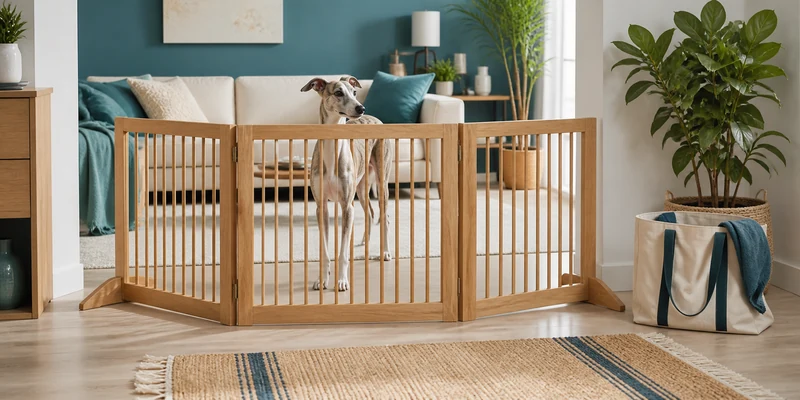
A freestanding dog gate solves the problem the other gate types cannot touch: the space with nothing to mount to. Open floor plans, wide living room entries, a kitchen that flows straight into the dining area, none of these give a pressure gate two parallel surfaces to grip or a hardware gate a stud to screw into. A freestanding gate simply stands where you put it, held up by its own feet or a zigzag fold, and moves the moment you want it somewhere else.
That flexibility comes with one honest catch, and this guide leads with it: a freestanding gate is a boundary your dog agrees to, not a lock. Below, how these gates stay upright, which dogs they work for, and the models worth your shortlist, from furniture-grade wood to heavy walk-through steel.
This article contains affiliate links. If you buy through them, we may earn a commission at no extra cost to you. Learn more.
Quick Answer
Is a freestanding dog gate enough for your dog?
- Yes for calm dogs that respect visual boundaries: it zones off wide or wall-less spaces no mounted gate can span, with zero drilling.
- Stability comes from wide support feet or a zigzag fold, plus real weight. Heavier gates with deeper feet resist pushing far better.
- No for pushers, jumpers, and escape artists, and never as a stair barrier. Those situations need a mounted gate or a sturdy pen.
What to Check on a Freestanding Gate
Freestanding gates live or die on stability, and you can judge most of it from the product listing. Here is the checklist.
| What to check | Why it matters | What to look for |
|---|---|---|
| Support feet | The feet are the only thing resisting a push | Wide, deep feet set perpendicular to the panels, or rubber-tipped angled supports |
| Weight | Mass is what a shove has to move | Solid wood or steel; the heavier gate of two similar designs is the steadier one |
| Panel configuration | A straight line is the least stable shape | Hinged panels that fold into a zigzag, which braces the gate against tipping |
| Height | Freestanding gates are jumped more than pushed | Around 24 inches suits small dogs; step toward 32 inches or more for bigger dogs |
| Walk-through door | Lifting a gate aside all day gets old fast | A latched door in the center panel on gates you cross frequently |
| Floor grip | Hard floors let the gate skate | Rubber pads or feet, or a rug under the gate line |
If you are still deciding between gate categories rather than models, the mounting comparison in our best dog gate hub is the place to start.
How a Gate Stands Up Without a Wall
Physics keeps a freestanding gate honest. A flat panel standing on edge tips over almost by itself, so every workable design adds leverage against tipping in one of two ways. The first is dedicated feet: perpendicular supports at each end, and ideally in the middle, that extend the gate’s footprint the way outriggers steady a crane. The second is geometry: three or more hinged panels arranged in a zigzag, so each panel braces its neighbors and the gate becomes its own tripod.
Both approaches work, and both have a failure mode. Feet add trip hazard and only resist force perpendicular to the panels, so a push along the gate line can still walk it across the floor. Zigzag gates give up span, since folding eats width, and they can be straightened by a dog that noses the hinge points. This is why weight is the quiet hero spec: a heavy hardwood or steel gate absorbs the casual bump, the curious paw, and the vacuum cleaner collision that send lightweight gates clattering down.
The behavioral fine print
A freestanding gate ultimately works because your dog treats it as a wall. Most settled adult dogs do, which is why these gates are so popular in living rooms. But a dog with real motivation, a delivery at the door, a cat on the far side, separation stress, will discover that the wall moves. If that describes your dog, skip to a mounted gate from our pressure mounted dog gate guide, or contain the dog fully in a pen instead.
Our Top Picks at a Glance
How we chose: we compared freestanding gates from Carlson, MidWest Homes for Pets, IRIS USA, and unipaws on stability design, weight, height options, and how consistently owners report them staying upright around real dogs. We work from manufacturer specifications and recurring review themes, not hands-on trials of our own.
A quick reassurance on looks: this is the one gate category where furniture-grade options are genuinely common, so you do not have to park a steel grid in your living room unless your dog requires it.
🏆 Best Overall
A wooden freestanding gate with a walk-through door and sturdy support feet, wide enough for large room openings. The balance of looks, span, and stability most living rooms are after.

💛 Best Value
A lightweight folding wooden gate that zigzags to stand on its own. Easy to reposition daily and gentle on budgets, best for small, polite dogs rather than determined ones.

🧱 Best Heavy-Duty
A heavy metal freestanding gate with a latched walk-through door. The mass and wide stance shrug off leaning and bumping that would flatten a wooden gate, making it the pick for big dogs.

Matching the Gate to Dog and Room
Small and calm dogs are the ideal freestanding customer: a modest folding gate zones the space, survives the occasional bump, and tucks behind the couch when guests come. For medium dogs, move up in weight and height, and favor designs with a walk-through door so the gate can live in a busy path without being lifted aside twenty times a day.
Large dogs split into two groups. The easygoing ones do fine behind a heavy wooden or steel gate with deep feet, especially when the gate spans a spot the dog was never desperate to cross. The powerful and persistent ones defeat freestanding gates as a category, not as individual products, and no amount of shopping fixes that. For those dogs, and for any spot where escape means danger, use a hardware-mounted gate or a heavy-duty pen; our best dog playpen hub covers the containment side. Households juggling several dogs with different sizes and rules will find layout strategies in our multi-dog household setup guide.
🐕 Best for Wide Room Openings
A configurable multi-panel gate that runs straight, bends around furniture, or folds into a freestanding play yard. The panel count, not a fixed frame, decides how far it spans.
🪵 Also Great: Furniture Look
A hand-carved wooden tri-fold gate in a warm finish that reads as a room divider rather than pet equipment. For calm dogs in spaces where the gate is always on display.

Placement, Setup, and Keeping It Upright
Position beats product here. Anchor at least one end of the gate against a wall, a doorway edge, or a heavy piece of furniture, so the dog cannot simply walk around it, and so pushes transfer into something solid. Angle the end panels or feet toward the dog’s side, which converts a push into downforce instead of tip. On hardwood or tile, put rubber pads under the feet or run the gate line across a rug, because a skating gate teaches the dog that the barrier is negotiable.
Check the gate the way your dog will: give it a firm push at the top edge, mid-span. If it tips or slides more than an inch or two, add weight at the feet, deepen the zigzag angle, or reposition against sturdier anchors before the dog runs the same experiment. And keep freestanding gates away from stairs entirely, top and bottom; a barrier that can move has no business near a drop.
Common Mistakes to Avoid
- Using a freestanding gate at the stairs. Stairs require a hardware-mounted gate. A gate that can shift is worse than no gate at a drop.
- Buying a straight two-panel gate for an open span. Without a zigzag or feet, it is a domino. Panels need geometry or outriggers to stand.
- Choosing light plastic for a big dog. Weight is the spec doing the work. A gate the dog outweighs five times over is a suggestion, not a barrier.
- Leaving both ends unanchored in the middle of a room. Dogs go around barriers before they go through them. Anchor the ends to walls or furniture.
- Forgetting floor grip. On smooth floors, add rubber feet or a rug line, or the gate migrates every time it is touched.
- Expecting it to hold an unattended escape artist. Freestanding gates are supervision tools. Full containment while you are away is a pen’s job.
Where to Go From Here
If your opening does have walls and you want more security for the same money, a tension gate is the stronger barrier: see the pressure mounted dog gate guide. Spanning a truly wide opening with mounting points at each end is the territory of the extra wide dog gate. And for the complete overview of which gate type fits which spot in the house, start at the best dog gate hub.
Frequently Asked Questions
Will a freestanding gate stop a large dog? A calm large dog, usually yes, if the gate is heavy with wide feet and anchored at the ends. A large dog that pushes, jumps, or badly wants the other side will move any freestanding gate; that dog needs a mounted gate or a pen.
Can I use a freestanding dog gate at the top of stairs? No. Any gate near stairs must be hardware-mounted so it cannot shift or fall. This mirrors the industry rule against pressure gates at the top of stairs; see our dog gate hub for the safe stair setup.
How do freestanding gates stay upright? Through footprint and geometry: perpendicular support feet act like outriggers, and multi-panel gates fold into a zigzag that braces itself. Weight then determines how much bumping that structure absorbs.
Do freestanding gates work on hardwood floors? Yes, with grip added. Rubber pads or feet stop the sliding, and running the gate line over a rug works just as well. Bare wood on bare hardwood tends to skate when pushed.
Freestanding gate or playpen? A gate divides a room; a pen contains a dog. If you need to leave the dog alone inside the boundary, especially a puppy, a playpen is the safer tool.
The Bottom Line
A freestanding dog gate is the right call for wide, wall-less spaces and dogs that respect a visual boundary: choose real weight, wide feet or a zigzag fold, and anchor the ends against walls or furniture. It is the wrong call for stairs, unattended escape artists, and dogs that physically challenge barriers, which need mounted gates or a pen. Match the gate to your dog’s temperament first and the room second, and this becomes the most flexible barrier in the house.