Last updated: August 10, 2026
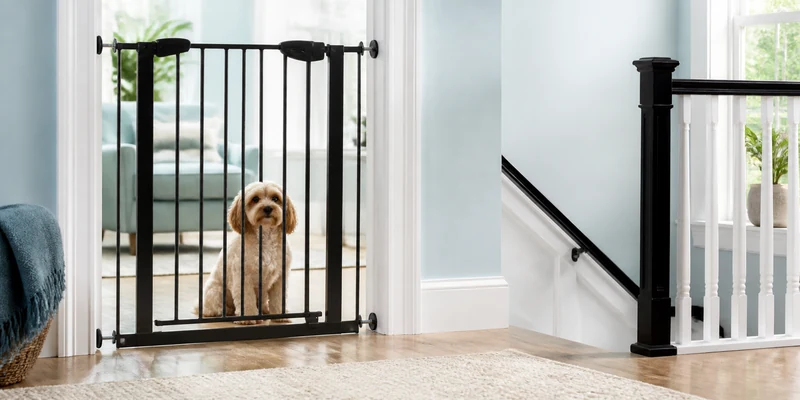
A pressure mounted dog gate is the barrier most homes actually need: it wedges into a doorway with adjustable tension, installs in minutes, and comes out without leaving a single hole in the wall. That makes it the default answer for renters, for anyone zoning off a kitchen during dinner, and for keeping a puppy out of the one room with the good rug.
But tension has limits, and knowing them in advance is the difference between a gate that quietly does its job for years and one that ends up flat on the floor with a proud dog standing on it. This guide covers how pressure mounting really works, where it must never be used, and which models fit which doorways and dogs.
This article contains affiliate links. If you buy through them, we may earn a commission at no extra cost to you. Learn more.
Quick Answer
Is a pressure mounted dog gate right for your home?
- Yes for doorways, hallways, and the bottom of stairs: it grips two parallel surfaces with tension and needs no drilling.
- No for the top of stairs, ever. Tension can be pushed loose, so that spot requires a hardware-mounted gate screwed into studs or a banister.
- Use the included wall cups and keep your opening in the middle of the gate’s width range, and a tension gate will hold up to years of daily traffic.
What to Check Before You Buy
Every spec on a pressure gate listing maps to a real-world behavior. Here is how to read them.
| What to check | Why it matters | What to look for |
|---|---|---|
| Width range | Tension weakens near the outer limit of the extensions | Your opening measured at its narrowest point, sitting comfortably mid-range |
| Height | Standard heights contain most dogs, not jumpers | Around 30 inches for most dogs, 36 inches or more for athletic breeds |
| Walk-through door | Gates you step over get knocked over | A one-hand latch and a door that swings shut behind you |
| Wall cups included | Bare pads slide on drywall and dent trim | Screw-in or adhesive cups in the box, and a plan to actually use them |
| Bar spacing | Puppies and small dogs exploit wide gaps | Narrow vertical bars with no horizontal footholds for climbers |
| Bottom threshold bar | Every tension gate has one; it is a trip point | A low-profile bar, and placement where nobody rushes through in the dark |
If several of these checks are failing at once, usually because the opening is too wide or there is nothing to grip, the fix is a different category: see our hub guide to picking the best dog gate type for your layout.
How Pressure Mounting Actually Works
A pressure gate is a rectangle with four adjustable pads, two per side, that push outward against the door frame or walls. You set the frame in place, tighten the tension knobs, and friction does the rest. Nothing penetrates the wall, which is why this style dominates in rentals and in any home where drilling into trim feels like vandalism.
The physics also explains every limitation. The gate holds exactly as well as its pads grip, so it needs two flat, parallel, solid surfaces. Rounded banister posts, wavy plaster, or an opening at the very end of the gate’s extension range all reduce grip. And because the whole system relies on outward force, repeated impacts gradually loosen it, which is normal and fixable with a periodic re-tightening, not a defect.
The wall cup trick
Wall cups are small plastic saucers that mount to the wall and cradle each tension pad. They spread the load over a wider area, stop the pads from creeping under vibration, and protect paint and trim from dents. Most complaints about pressure gates loosening trace back to skipped wall cups. Screw them in where you are allowed to; the adhesive versions are the renter’s compromise and still far better than bare pads. More damage-free setups like this live in our guide to dog furniture for renters.
The Top-of-Stairs Rule Is Absolute
No pressure mounted gate belongs at the top of a staircase. This is not a brand quality issue, it is built into how tension works: if the grip fails while a dog, child, or adult is leaning on the gate, everything falls downstairs together. Manufacturers state this restriction on the packaging of pressure gates across the industry.
At the top of stairs, use a hardware-mounted gate that screws into wall studs or the banister. Most major brands sell hardware versions or banister adapter kits precisely for this spot. A second advantage: hardware stair gates typically have no bottom threshold bar, removing a trip hazard exactly where a stumble is most dangerous. Pressure gates remain a fine choice at the bottom of the same staircase, where a dislodged gate simply falls flat on the floor.
Our Top Picks at a Glance
How we chose: we compared pressure-mounted gates from Carlson, Regalo, and PetSafe on tension security, latch convenience, width and height options, and how consistently owners report them staying tight in daily use. We rely on manufacturer specifications and recurring review themes rather than hands-on testing of our own.
All three picks install without tools and come out clean, so nothing here threatens a security deposit.
🏆 Best Overall
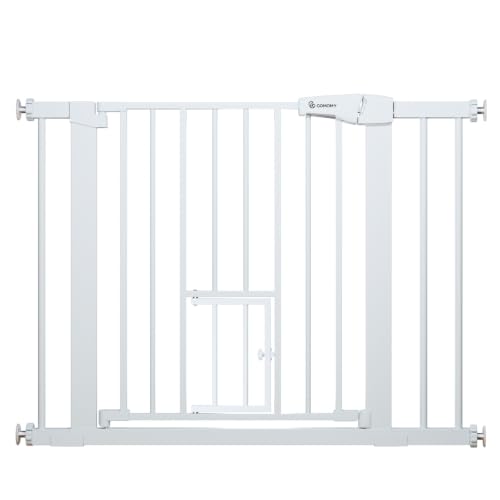
A steel walk-through gate with a generous width range and a built-in small pet door, so a cat or tiny dog can pass while the boundary holds for everyone else. The all-around answer for doorways and hallways.
💛 Best Value
The bare-essentials walk-through tension gate: steel frame, lever latch, included wall cups. It skips the extras and keeps the part that matters, a door you can open with one hand.

🐕 Best Extra Tall
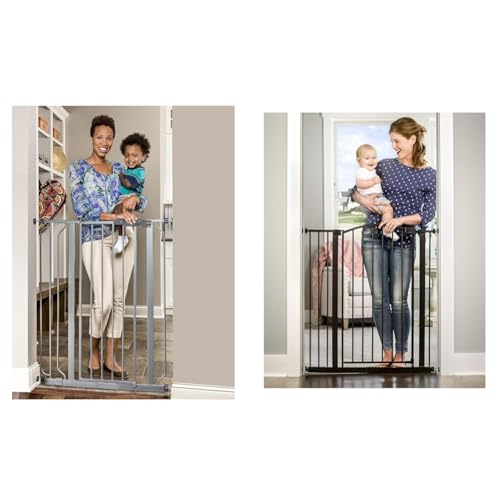
A taller version of the classic walk-through design for jumpers and long-legged dogs. Same tool-free tension mounting, with enough height that clearing it stops being worth the effort.
Matching the Gate to the Dog
Size drives the choice more than breed. For small dogs and puppies, standard height is plenty, but bar spacing and the gap under the frame become the escape routes to check. For medium dogs, the standard walk-through gate is the sweet spot, provided you keep the tension maintained. For large and powerful dogs, be honest about behavior: a big dog that respects boundaries is fine behind a tension gate, while a big dog that throws its weight at barriers will eventually win against friction, and belongs behind a hardware-mounted gate or a heavy-duty pen instead.
Watch your dog’s escape style, too. Jumpers are solved with height. Climbers need smooth vertical bars with no crossbar footholds. Pushers and diggers are the ones that defeat tension over time, and for them the mounting method matters more than any other spec. Dogs that need full containment for hours, rather than a blocked doorway, do better in a pen: our best dog playpen guide covers that scenario.
🐾 Best for Small Dogs and Puppies
A lower pressure-mounted steel gate with tight bar spacing and its own auto-close door, unobtrusive for people but a real wall for a small dog. A practical pick for hallways with constant human traffic.

🚪 Best for Wide Doorways
A pressure-mounted walk-through gate that adjusts to openings well past standard doorway width. Sizing it mid-range keeps the tension system centered instead of stretched to its limit.

Getting the Installation Right
Measure the opening at the height where the pads will sit, not at the floor, because baseboards and door stops change the number. Set the gate in place, tighten opposite corners evenly the way you would lug nuts on a wheel, and stop when the frame resists a firm shake without bowing. Overtightening bows the frame, which paradoxically weakens grip and can make the latch bind.
Then make maintenance a habit. Re-check tension after the first week while the pads settle, and monthly after that. If the gate keeps loosening in the same spot, the surface is the problem: add wall cups, or shim a slightly out-of-square frame so the pads sit flat. A tension gate that is set up and maintained like this rarely gives trouble; the ones in the one-star reviews were almost always stretched, cupless, or in the wrong location entirely.
Common Mistakes to Avoid
- Top of the stairs. The one non-negotiable. Hardware-mounted only, no matter how tight the tension feels today.
- Buying the exact width of your opening. You need adjustment room on both sides. Mid-range fit, always.
- Skipping wall cups on drywall. Bare pads creep, dent, and slide. The cups are in the box for a reason.
- Stepping over instead of using the door. Sooner or later a foot catches the frame. Buy walk-through, then walk through.
- Ignoring the threshold bar. Every pressure gate has one at floor level. Warn the household and keep the path lit at night.
- Expecting tension to out-muscle a determined dog. Friction is not a lock. Persistent pushers need hardware mounting or a pen.
Where to Go From Here
If your opening is wider than a doorway or has nothing solid to grip, the extra wide dog gate guide covers configurable panel systems, and the freestanding dog gate guide covers barriers that need no walls at all. For the full decision tree across every gate type, start at the best dog gate hub.
Frequently Asked Questions
Do pressure mounted gates damage walls? Used with their wall cups, they leave at most faint marks or a little adhesive residue. Without cups, the pads can dent drywall and scuff painted trim over time, which is the damage renters actually get charged for.
Can a pressure gate go at the bottom of the stairs? Yes. The bottom of a staircase is a normal doorway-style location, since a dislodged gate falls flat on the floor rather than down the steps. Only the top of the stairs requires hardware mounting.
How tight should a pressure gate be? Tight enough that the frame resists a firm two-hand shake without shifting, but not so tight that the frame visibly bows or the latch binds. Re-check after the first week and then monthly.
Why does my gate keep coming loose? Usually one of three causes: the opening is at the outer edge of the width range, the pads sit on bare drywall without cups, or a dog is repeatedly jumping on the gate. Fix the fit and the cups first, then reconsider the location.
Will a pressure gate hold a large dog? A calm large dog, yes, especially with wall cups and a mid-range fit. A large dog that charges or leans on barriers will loosen any tension system eventually, and is better served by a hardware-mounted gate or a heavy-duty playpen.
The Bottom Line
A pressure mounted dog gate is the right tool for doorways, hallways, and the bottom of stairs: fast to install, kind to walls, and secure when fitted mid-range with its wall cups. It is the wrong tool at the top of stairs and against dogs that physically battle barriers, both of which call for hardware mounting. Measure the narrowest point of your opening, use the cups, re-tighten monthly, and the gate disappears into the background of the house.