Last updated: August 10, 2026
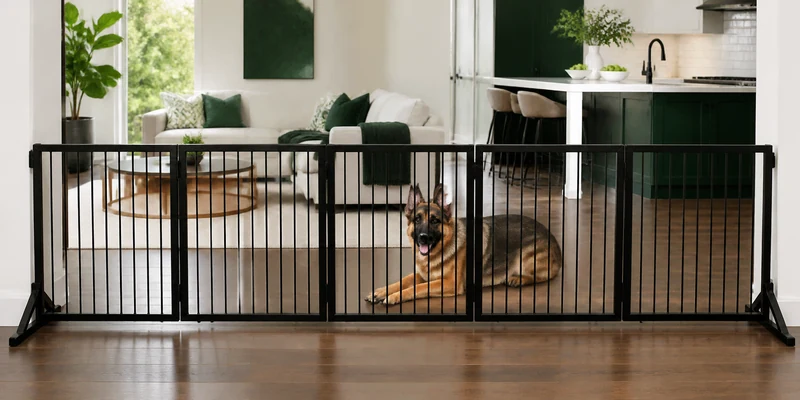
An extra wide dog gate exists because builders stopped building doorways. Open floor plans replaced hallways with room-to-room openings of five, six, ten feet and more, and a standard gate that tops out around four feet of span simply has nothing to offer there. The category answer comes in two flavors: fixed walk-through gates grown wider with extension panels, and configurable multi-panel systems that chain sections together until the gap is closed.
The wider the span, the more the engineering matters, because a long barrier catches more force and has more ways to sag, bow, or fold. This guide covers how to measure a wide opening properly, when extensions beat panels and the reverse, and the models that hold their line across a big gap.
This article contains affiliate links. If you buy through them, we may earn a commission at no extra cost to you. Learn more.
Quick Answer
Which extra wide dog gate fits your opening?
- Openings a bit past doorway width: a walk-through gate with extension panels keeps the door centered and the setup clean.
- Truly wide or irregular spans: a configurable multi-panel gate that mounts to a wall at each end and bends around corners.
- Pressure mounting weakens as spans grow, so on wide openings favor hardware mounting at the ends, and never use pressure at the top of stairs.
What to Check on a Wide-Opening Gate
Wide gates fail differently than doorway gates, so the shopping checklist shifts. These are the specs that decide the outcome.
| What to check | Why it matters on wide spans | What to look for |
|---|---|---|
| True measured span | Wide openings are rarely square | Measure at gate height in two or three places and use the narrowest figure |
| Extension vs panels | Extensions stretch one frame; panels add sections | Extensions for modest overshoot, linked panels once the span gets serious |
| Mounting at the ends | Tension loses grip as frames grow | Hardware brackets or wall-mount hinges on anything past extension territory |
| Rigidity mid-span | Long barriers bow where they are farthest from support | Steel panels, solid hinge pins, and a center that resists a firm push |
| Walk-through door | You will cross a wide barrier constantly | A latched door panel positioned in the household’s natural walking line |
| Height and bar spacing | Same dog, same rules, longer gate | Roughly 30 inches or more for most dogs, narrow bars for puppies |
Openings with no side walls at all push you out of the wide-gate category and into freestanding territory, which has its own stability rules; our freestanding dog gate guide covers that path.
Extensions or Panels: Two Ways to Grow a Gate
Extension-based gates start as a normal walk-through frame and accept add-on sections at one or both sides. The appeal is simplicity: one latch, one door, a familiar installation, and a finished look. The limit is structural. Each extension moves the mounting points farther from the door, and on pressure-mounted models every added inch dilutes the tension, which is why manufacturers cap extension stacks and why gates at maximum stretch draw the wobble complaints.
Panel systems flip the logic. Instead of one frame, you get a chain of hinged sections, often six or eight, that you shape to the space: a straight fence across a wide opening, an L around a kitchen island, or a closed pen when you need containment instead of division. Mounted to a wall at each end with hardware brackets, a panel system turns a huge opening into a firm barrier with a swinging door panel in the middle. The trade-offs are a bulkier presence, a slower first setup, and hinges that need to be solid, because every joint is a potential fold point when a dog leans in.
The wide-gate mounting rule
The wider the span, the stronger the case for hardware mounting. Pressure mounting a modestly extended gate in a solid opening works; pressure mounting a maximally stretched frame is asking friction to do a bolt’s job. And the staircase rule from our best dog gate hub applies unchanged here: the top of the stairs takes hardware-mounted gates only, at any width.
Our Top Picks at a Glance
How we chose: we compared wide-span gates from Carlson, Regalo, MidWest Homes for Pets, and unipaws on maximum span, mounting strength, mid-span rigidity, and how consistently owners report them staying solid across big openings. We work from manufacturer specifications and recurring review themes rather than our own hands-on testing.
Do not buy more span than you need: a gate sized close to your opening, mounted well, beats a huge system folded awkwardly into a smaller gap.
🏆 Best Overall
A walk-through gate with a built-in small pet door that grows with extension panels, covering openings well past standard doorway width while keeping one clean frame and latch.

🐕 Best for Very Wide Openings
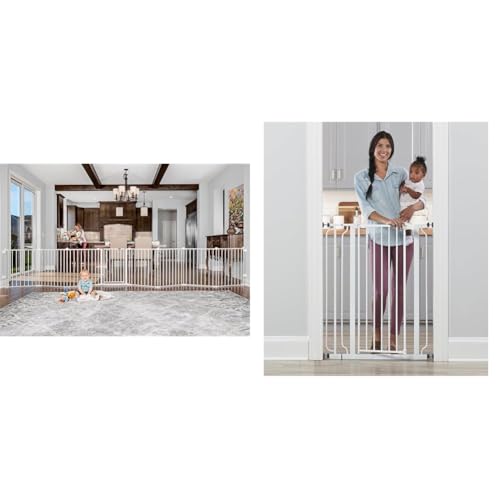
The configurable panel classic: linked sections that span big room openings, bend around corners, or close into a play yard. Mounts to walls at the ends for a firm hold.
💛 Best Value
A budget walk-through frame with included extensions for openings moderately past doorway width. The straightforward choice when your gap is wide but not wild.

Wide Gates by Situation
Kitchen-to-living-room openings are the classic case: two solid side walls, a span too wide for a standard frame, constant human traffic. An extension gate or a wall-mounted panel system with a walk-through door handles it, and the door position matters more than the brand, so put it where people naturally cross. For hallway mouths and split-level transitions with sturdy walls, hardware-mounted panel systems give the most rigid result and remove the threshold-bar trip point of tension designs.
Big dogs raise the stakes on wide gates specifically, because a long barrier is a long lever: force at mid-span works on the mounts harder than the same force on a narrow gate. For heavy leaners, favor steel over wood, hardware over pressure, and more mounting points over fewer. If the dog treats barriers as a contest, a wide gate may be the wrong tool entirely; full containment in a heavy pen is often calmer for everyone, and our best dog playpen hub covers those options.
🧱 Best Heavy-Duty Freestanding
A weighty metal gate that stands on its own with a walk-through door, for wide spots where mounting is impossible. Its mass is the feature: casual bumps and leans do not move it.

🪵 Also Great: Furniture Look
An extra wide wooden freestanding gate with support legs that reads as a room divider. For calm dogs in living spaces where a steel fence line would dominate the decor.

Measuring and Mounting a Wide Span
Measure like a skeptic. Wide openings drift out of square more than doorways, so take the width at gate height on both ends and in the middle, then plan around the narrowest number. Note what the ends offer: drywall over studs takes hardware brackets happily, a stone fireplace surround or metal railing does not, and half-walls change what height the mounts can sit at. Photograph the opening with a tape measure in frame before you shop; it settles most product-page doubts instantly.
When installing a panel system, mount the end brackets into studs, set the door panel in the traffic line, and angle any surplus panels slightly rather than forcing a dead-straight run, since a shallow zigzag adds rigidity the same way it does for freestanding gates. Then do the shake test at mid-span, where the gate is weakest: a firm push should meet the whole structure, not a single flexing panel. Re-tighten hinge pins and brackets after the first week of real use.
Common Mistakes to Avoid
- Maxing out the extensions. A frame at its outer limit is a frame at its weakest. If you need every extension in the box, you need the next category up.
- Pressure mounting a huge span. Tension thins out over width. Wide openings deserve hardware brackets at the ends.
- Measuring once, in one spot. Wide openings are rarely square. Narrowest measurement wins, always at gate height.
- Ignoring the door position. A wide gate with the door at the wrong end reroutes the whole household. Put the door in the walking line.
- Assuming panel hinges are all equal. Every hinge is a fold point. Owner reviews mentioning sag and fold at the joints are the warning to heed.
- Using any of this at the top of stairs without hardware. Width changes nothing about the stair rule: hardware mounting only.
Where to Go From Here
If reading this made your opening sound like a normal doorway after all, the pressure mounted dog gate guide has the simpler answer. Wall-less spaces belong to the freestanding dog gate. And the full map of gate types by location is at the best dog gate hub.
Frequently Asked Questions
How wide can a dog gate go? Extension-based walk-through gates typically cover openings modestly past standard doorway width. Configurable panel systems span far wider, with popular models linking panels into runs of well over ten feet when wall-mounted at the ends.
Can an extra wide gate be pressure mounted? Only at modest widths and in solid, square openings. As spans grow, tension loses its grip advantage, and hardware mounting becomes the reliable choice. At the top of stairs, hardware is mandatory at any width.
What is the difference between an extra wide gate and a play yard? Usually just the shape of the same panels. Chained open and wall-mounted, the panels are a gate; closed into a loop, they are a pen. Many products, including our very-wide pick, convert between both; see our dog playpen guide for the pen side.
Will a wide gate hold a large, strong dog? A hardware-mounted steel system, mounted into studs, generally yes. A stretched pressure frame or a light wooden gate, not for long. For dogs that actively challenge barriers, prioritize mounting strength over width features.
Do I need a walk-through door in a wide gate? In practice, yes. The wider the barrier, the longer the detour around it, and gates that force a climb or a full removal get left open. A latched door panel keeps the barrier honest.
The Bottom Line
For an opening slightly past doorway size, an extra wide walk-through gate with extensions is the clean, simple answer. For genuinely wide or angled spans, a configurable panel system hardware-mounted at both ends is the barrier that actually holds. Measure the narrowest point at gate height, favor hardware over tension as width grows, and put the walk-through door where the household really walks.