Last updated: August 10, 2026
A dog gate looks like the simplest purchase in the pet aisle, and that is exactly why so many of them end up returned. The gate that works beautifully in a standard doorway can be genuinely unsafe at the top of a staircase, and the gate that holds back a ten-pound terrier folds the first time a Labrador leans on it. Before you compare brands, you need to answer two questions: where is the gate going, and what kind of dog is on the other side of it?
This guide walks you through the four gate types, the one safety rule that is not negotiable, and how to measure your opening so the gate you order actually fits. Then we get to specific picks for the most common situations, from rental apartments to wide open floor plans.
This article contains affiliate links. If you buy through them, we may earn a commission at no extra cost to you. Learn more.
Quick Answer
Which dog gate should you get?
- For hallways and doorways on one level, a pressure-mounted walk-through gate is the easiest choice and needs no drilling.
- At the top of stairs, only a hardware-mounted gate that screws into the wall or banister is safe. A pressure gate can be pushed loose there.
- For wide or irregular openings, look at freestanding gates or configurable multi-panel gates rather than forcing a standard gate to stretch.
The Four Dog Gate Types at a Glance
Every dog gate on the market falls into one of four categories, and the right one is decided by the opening, not the brand. Use this table to narrow down the type before you look at a single product.
| Gate type | How it installs | Best for | Keep in mind |
|---|---|---|---|
| Pressure-mounted | Tension between two flat surfaces, no drilling | Doorways, hallways, bottom of stairs, rentals | Never at the top of stairs; needs two parallel surfaces to grip |
| Hardware-mounted | Screwed into studs, door frames, or banisters | Top of stairs, strong dogs, permanent spots | Leaves screw holes; installation takes real tools and time |
| Freestanding | Stands on its own feet or angled panels | Wide rooms, flexible zoning, calm dogs | A determined dog can push or knock it over; not a true barrier |
| Extra-wide / configurable | Multiple linked panels, mounted or freestanding | Open floor plans, staircases with no walls, odd angles | Bulkier and harder to move once set up |
If your opening is wider than a standard doorway, jump straight to our dedicated guide to the extra wide dog gate options, because stretching a standard gate past its rated width is where most wobble complaints come from.
Pressure-Mounted or Hardware-Mounted: The Safety Rule First
Here is the rule that outranks every feature comparison: a pressure-mounted gate should never be used at the top of a staircase. A pressure gate holds itself in place by pushing outward against two surfaces. A dog jumping up on it, a child leaning on it, or simply months of daily bumping can break that tension, and at the top of stairs the gate then falls in exactly the direction you bought it to protect. Gate manufacturers print this warning on the box for a reason.
Hardware-mounted gates screw directly into wall studs, door framing, or a banister, so there is no tension to lose. They also have no bottom threshold bar in most designs, which removes a trip hazard right where you least want one. The trade-off is holes in your woodwork and a slower installation. If you rent and cannot drill, the honest answer is to gate the bottom of the stairs with a pressure gate instead, and we cover more damage-free options in our guide to dog furniture for renters.
Everywhere that is not a staircase
On flat floors the pressure gate deserves its popularity. A good one installs in minutes, holds firmly against a doorway with the included wall cups, and comes out clean when you move. For most homes the ideal setup is one hardware-mounted gate at the top of the stairs and pressure-mounted walk-through gates everywhere else. Our full breakdown of tension gates, including how to get them truly tight, is in the pressure mounted dog gate guide.
Measure the Opening, Then Measure the Dog
Fit problems cause more gate returns than quality problems. Measure the opening at the exact height where the gate will sit, because baseboards, door stops, and trim can make the bottom narrower than the top. Write down the narrowest number and compare it to the gate’s stated range, staying comfortably inside it rather than at the outer limit of the extensions.
Then look at your dog. Height matters for jumpers: a standard gate around 30 inches tall contains most dogs, but athletic breeds and dedicated escape artists need an extra-tall model closer to 36 inches or more. Bar spacing matters for small dogs and puppies, since wide gaps at the bottom are an open invitation. And weight matters for the mounting decision, because a big dog that habitually leans or paws at barriers is a strong argument for hardware mounting even on flat floors. If you are unsure how your dog’s size translates to product choices, our explainer on how to measure your dog for furniture walks through it.
Our Top Picks at a Glance
How we chose: we compared widely sold gates from Carlson, Regalo, MidWest Homes for Pets, and their peers on mounting security, walk-through convenience, height and width range, and how consistently owners report them standing up to daily use. Selections lean on manufacturer specifications and recurring themes in customer reviews rather than any hands-on trial of our own.
One reassurance before the list: the leading gate brands share most of their core engineering, so you are mainly paying for width range, height, and convenience features like a one-hand latch or a built-in small-pet door. Pick for your opening and your dog, not for the longest feature list.
🏆 Best Overall
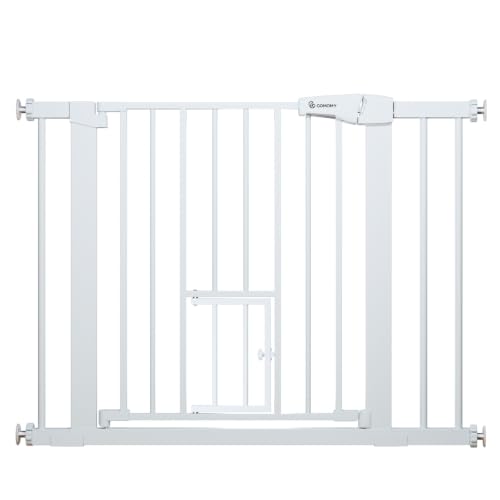
A pressure-mounted walk-through gate with a wide fitting range and a small pet door at the bottom, so cats or tiny dogs can pass while the big dog stays put. The default choice for doorways and hallways.
💛 Best Value
The classic budget walk-through gate: simple steel frame, a hold-open auto-close door, tool-free pressure mounting. It does the one job most homes need without extras.

🪜 Best for Stairs
A hardware-mounted walk-through gate that screws into the wall or stair framing, which is the only safe configuration at the top of a staircase. Slower to install, but it cannot be pushed loose.

Freestanding Gates and Open Floor Plans
Modern layouts are the dog gate’s natural enemy. When the kitchen flows into the living room with no doorway in sight, there is nothing for a pressure gate to grip. Two families of products solve this. Freestanding gates stand on their own feet or fold into a zigzag that keeps them upright, and they shine as flexible, furniture-friendly zoning for dogs that respect a visual boundary. Configurable multi-panel gates link several sections into one long barrier that can run straight, bend around corners, or anchor to walls at each end.
Be honest about your dog before choosing the freestanding route. A gate that merely stands there will not stop a strong dog that wants the other side; it works because the dog accepts it. For pushers, jumpers, and determined escape artists, choose a mounted barrier or a heavy-duty pen instead. The full trade-offs, including which designs resist tipping best, are in our freestanding dog gate guide.
Picks for Wider and Trickier Spaces
These are the gates we point people to once a standard doorway model stops being the answer.
🐕 Best for Very Wide Openings
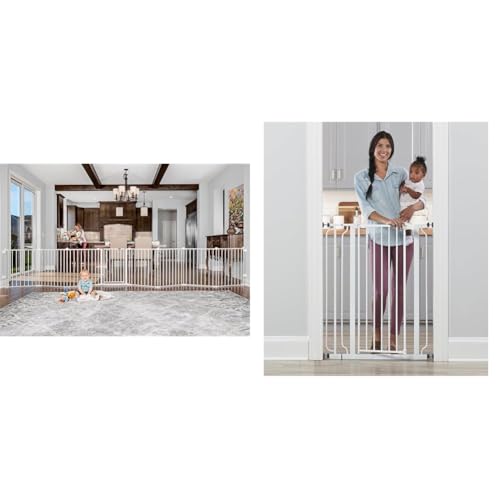
A configurable multi-panel gate that spans wide room openings or folds into a freestanding play yard. The panels bend around corners, which fixed-width gates simply cannot do.
🪵 Best Freestanding
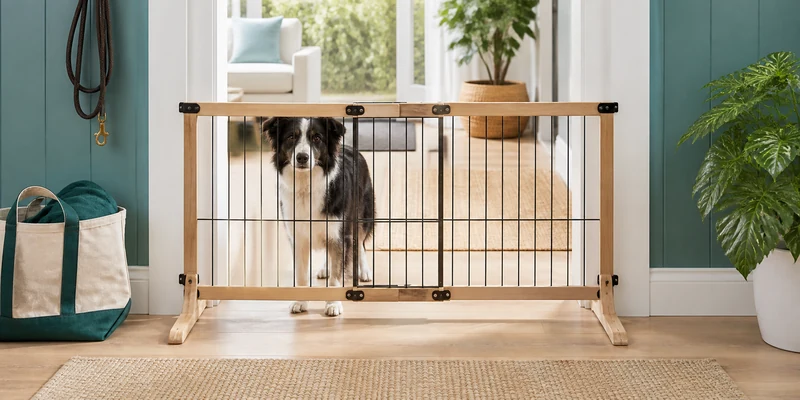
A wooden freestanding gate with angled support feet that looks like furniture rather than hardware. A good match for calm dogs and living rooms where a steel gate would feel out of place.

🧱 Best Heavy-Duty Freestanding
A heavy metal freestanding gate with a walk-through door, substantially weightier than wooden alternatives, so it takes leaning and bumping in stride. Suited to bigger dogs in open layouts.

Installation and Living With a Gate
For pressure gates, always use the included wall cups. They screw or stick to the wall and cradle the gate’s tension pads, which spreads the load, protects the paint, and roughly doubles how much abuse the gate absorbs before loosening. Set the tension so the gate resists a firm shake, then re-check it after the first week, because pads settle into drywall and trim.
For hardware gates, find the studs rather than trusting drywall anchors alone, and mount the latch side where adults can reach it naturally while carrying laundry or a coffee. Walk-through doors that open both directions and swing shut on their own earn their keep within a day; a gate you have to step over gets resented, and stepped-over gates eventually get knocked over.
Teach the gate, not just the doorway
Give your dog a reason to accept the boundary: a bed, water, and something to chew on the dog’s side of the gate turn confinement into a settled zone rather than a barricade to protest. If the gated area doubles as a den space, our guide to crate training in a furniture crate covers the same settling principles in more depth.
Common Mistakes to Avoid
- Putting a pressure gate at the top of stairs. This is the one genuinely dangerous gate mistake. Top of stairs means hardware-mounted, every time.
- Buying at the edge of the width range. A gate stretched to its last extension holds tension poorly. Size the gate so your opening sits in the middle of its range.
- Ignoring bar spacing with a puppy. A gate that contains an adult dog can let a small puppy squeeze straight through the bars or under the frame.
- Skipping the wall cups. Bare tension pads slide on drywall and dent trim. The cups take two minutes and prevent most loosening complaints.
- Choosing freestanding for a dog that pushes. Freestanding gates manage polite dogs. A determined dog needs a mounted gate or a pen.
- Forgetting who else lives there. If a cat needs to cross the boundary, a gate with a built-in small pet door saves you from propping the gate open, which defeats the whole point.
Where to Go From Here
If your opening is a normal doorway, start with the pressure mounted dog gate guide and you will likely be done. Wide or wall-less spaces are covered in the extra wide dog gate roundup. And if what you really need is containment your dog can be left inside, not just a doorway blocker, a pen is the better tool: our best dog playpen hub explains when to choose which.
Frequently Asked Questions
Can I use a baby gate for a dog? Often yes, since the leading brands build both and the engineering overlaps heavily. Check that the height suits your dog, the bar spacing is too narrow to squeeze through, and the materials can handle chewing and pawing, which pet-specific models are designed around.
How tall should a dog gate be? Around 30 inches contains most dogs on flat ground. For athletic jumpers, escape-prone breeds, and large dogs, move to an extra-tall model of roughly 36 inches or more, and watch whether your dog climbs rather than jumps, because climbers need vertical bars without footholds.
Why can’t a pressure gate go at the top of stairs? Because it is held only by outward tension, and any loss of that tension lets the whole gate fall down the staircase, potentially with a dog or person against it. Only a hardware-mounted gate screwed into studs or a banister is safe there; see the mounting section above, and the pressure mounted dog gate guide for where tension does belong.
Do dog gates damage walls? Hardware gates leave screw holes by design. Pressure gates used with their wall cups leave at most small marks or adhesive residue, which is why they are the standard recommendation for rentals.
What if my dog jumps or knocks the gate down? Move up in height, switch from freestanding to mounted, and make the gated side more rewarding to stay in. For repeat offenders, a heavy-duty playpen is usually more effective than an ever-taller gate.
The Bottom Line
Choose the mounting before the model: hardware-mounted at the top of stairs without exception, pressure-mounted walk-through gates for doorways and hallways, and freestanding or configurable panels for wide open layouts with calm dogs. Measure the narrowest point of your opening, size the gate to the middle of its range, and match the height and bar spacing to your actual dog. Do that and almost any gate from the major brands will serve you for years.